

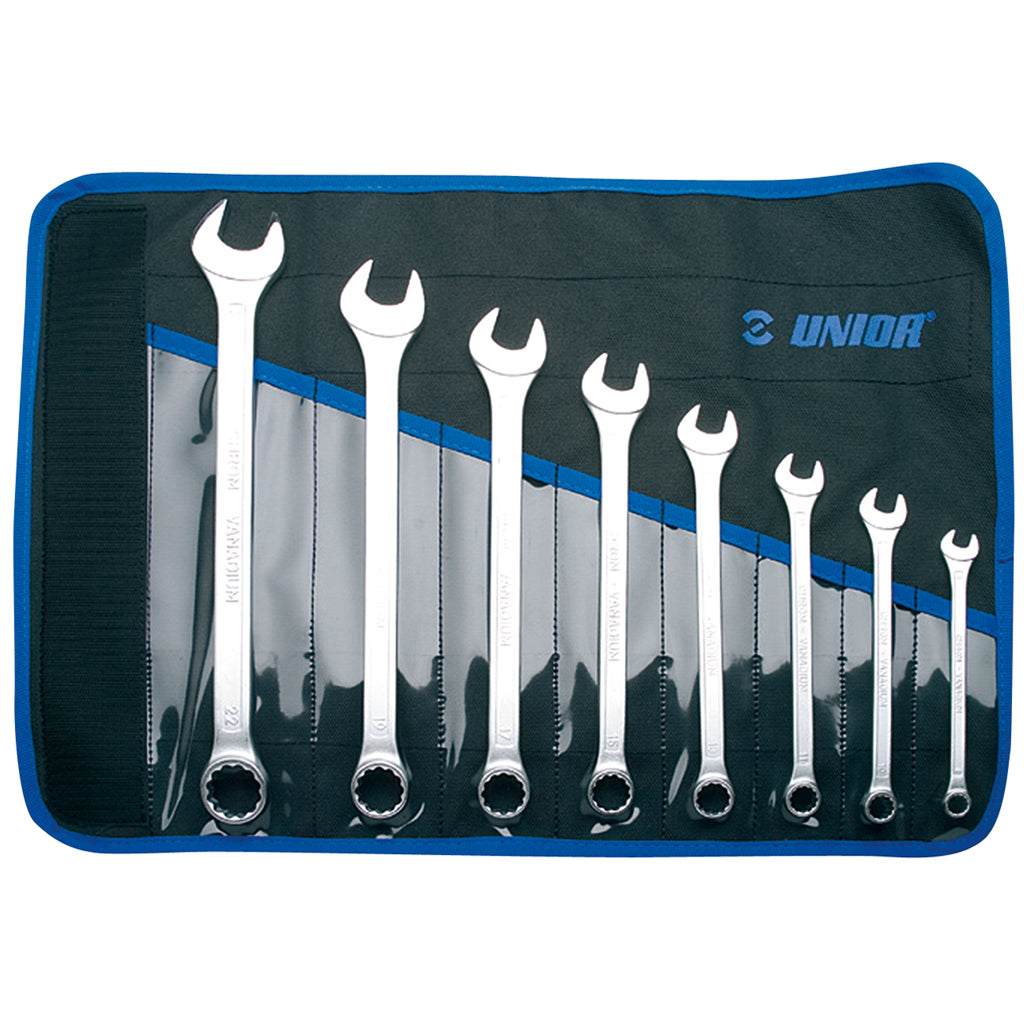
Eight long-handle combination wrenches, from 8 to 22 mm, in a 470 × 330 mm tool roll. Drop-forged chrome vanadium steel with 12-point ring ends; the longer handles turn the same hand force into more torque for stuck pedals and seized fasteners. The complete set weighs 1050 g.
Low stock
Couldn't load pickup availability
Free US shipping on orders $75+
Some exceptions apply — see shipping policy
Forged in Zreče, Slovenia since 1919. Sponsors professional road and mountain-bike race teams.
In the box
-
8 mm combination wrench, long type 141 mm long, 23 g 120/1
-
10 mm combination wrench, long type 163 mm long, 37 g 120/1
-
11 mm combination wrench, long type 176 mm long, 45 g 120/1
-
13 mm combination wrench, long type 199 mm long, 68 g 120/1
-
15 mm combination wrench, long type 222 mm long, 96 g 120/1
-
17 mm combination wrench, long type 245 mm long, 144 g 120/1
-
19 mm combination wrench, long type 268 mm long, 186 g 120/1
-
22 mm combination wrench, long type 303 mm long, 266 g 120/1
On this page
Long-handle combination wrenches are the right answer when the job calls for leverage. A stuck pedal axle, a high-torque BB lockring that needs to break loose, a crank-arm bolt that's seated harder than expected; these are the cases where the extra inch or two of handle length is the difference between cracking the fastener loose and stripping it.
The 120/1CT set covers eight sizes from 8 to 22 mm in the longer form, in a polyester tool roll. Twelve-point box ends across the set.
What's in the set
Eight combination wrenches in long-handle form:
- 8 mm
- 10 mm
- 11 mm
- 13 mm
- 15 mm
- 17 mm
- 19 mm
- 22 mm
The same size range as the short-handle set; only the handle length differs.
Why length matters
Length on a combination wrench is the lever arm. Double the length and you double the torque at the same hand force. The math is unforgiving; a 200 mm wrench applying 100 N of hand force delivers 20 Nm; a 300 mm wrench at the same hand force delivers 30 Nm. For fasteners that need real torque to break loose or seat to spec, length is the cheapest mechanical advantage there is.
The trade-off is geometry: a long wrench needs clearance to swing. In tight workspaces, the short-handle set is the right tool. Most shops own both formats.
Where the long-handle earns its space
- Pedal axles. 15 mm flats, often stuck after a season; the long handle delivers the torque to break them loose without rounding the flats.
- BB lockrings. Where the lockring has flats rather than an internal-toothed socket interface.
- Crank-arm bolts (older designs). External 14 or 17 mm hex heads on pre-Hollowtech crank designs.
- Headset adjustment nuts. Larger 22 mm headsets on older builds.
- Anywhere the working space is open and the fastener is reluctant.
The 12-point box-end
Same trade-off as the short-handle set: 12-point engages at corners (faster fit, twelve angular positions per rotation) but can round alloy fasteners under high torque. For very high-torque alloy work (a stuck crank-arm bolt on a soft-alloy crank, for example), a 6-point socket driven by a 1/2-drive ratchet is the safer tool. For most bike-shop fastener work, the 12-point combination wrench is fine.
Specs
- Sizes: 8, 10, 11, 13, 15, 17, 19, 22 mm
- Form: long-handle combination
- Box-end: 12-point
- Storage: polyester tool roll with velcro closure, 470 × 330 mm (spare bag: Unior article CT129)
- Construction: drop forged, entirely hardened and tempered chrome vanadium steel; complete set weight 1050 g
Made in Slovenia, since 1919
Unior has been forging hand tools in Zreče since 1919, and sponsors professional road and mountain-bike race teams. The handle length on each wrench is sized to the torque range its size will see in service; the 22 mm gets more handle than the 8 mm, because the 22 mm is what's used on high-torque fasteners that need the leverage. That's a quiet design choice; most combination wrench sets scale handle length linearly with jaw size, which gives you too much handle on the small sizes and not enough on the big ones.
Pro tip from our mechanics
The 15 mm in this set is the one that earns its keep on pedal day. Once a year, when a customer brings in a bike with pedals that haven't been off in two seasons, the long-handle 15 mm is what gets the pedal moving without rounding the flats. For the framework on combination wrench types: Combination wrenches in the bike shop →.
FAQ
Which wrench sizes come in the long-handle set? 8, 10, 11, 13, 15, 17, 19 and 22 mm, one wrench per size, with the open end and the 12-point ring end cut to the same size. In-between sizes such as 9, 12, 14 and 16 mm are not included, so check your fastener sizes before relying on the set alone.
How long are the wrenches compared with a standard set? The 8 mm is 141 mm long and the 22 mm reaches 303 mm; for comparison, the same sizes in Unior's short 125/1 series run 119 mm and 247 mm. The extra handle length delivers more torque at the same hand force, which is what frees stuck pedals and seized fasteners.
Can I replace the tool roll if it wears out? Yes. Unior lists the bag separately as article CT129, so a worn roll can be replaced without re-buying the wrenches. The roll measures 470 × 330 mm, and the complete set of eight wrenches weighs 1050 g.
What steel is used, and what standards do the wrenches meet? Premium chrome vanadium steel, drop forged, entirely hardened and tempered, with trivalent chrome plating to ISO 1456:2009 and polished heads. The wrenches are manufactured to ISO 7738, the combination wrench standard, and carry Unior's lifetime warranty.
 Tech Tips
How to install and remove bike pedals
Tech Tips
How to install and remove bike pedals
