Hex and Torx wrenches: how to pick the right tool for the job
A working mechanic's guide to choosing hex and Torx wrenches for bike maintenance. Sizes that matter, handle shape, ball-end vs straight-tip, stripped-bolt prevention.
On this page
Most bike maintenance comes down to two fastener types. If you can identify which one is in front of you and pick the right driver for the size, eighty percent of home shop work gets easier. The other twenty percent is everything else this guide covers: ball-end vs straight-tip, handle shape, when you need a socket bit on a torque wrench, and how to keep from rounding a bolt on a thousand-dollar component.
Hex and Torx, briefly
A hex bolt has a hexagonal recess; the driver is a six-sided shaft that matches the recess across the flats. Almost every bolt on a bike with a recessed head is a hex bolt: stem bolts, seatpost binder, cleat bolts on most pedals, water-bottle cage screws, derailleur limit screws (under a Phillips on some groupsets), brake-pad retention bolts on some calipers.
A Torx bolt has a six-pointed star recess (also called the T-profile). On a bike, Torx is most common on disc-brake rotor bolts (T25 across the industry on 6-bolt rotors), modern chainring bolts (often T30 on current Shimano and SRAM groups), and small electronic-shifter fasteners (T8 and T10 on some Di2 and AXS hardware).
The two profiles are not interchangeable. Forcing a hex driver into a Torx recess, or the reverse, is the fastest way to round a bolt past the point a regular driver can grip it.
The sizes that matter on a bike
You don't need every size on the shelf. The set below covers everything a typical road, MTB, or gravel bike will throw at you.
| Profile | Size | What it's on |
|---|---|---|
| Hex | 2 mm | Some derailleur limit screws; small grub screws on shifter clamps |
| Hex | 2.5 mm | Disc-brake caliper banjo bolts on some systems; some shifter clamps |
| Hex | 3 mm | Older shifter and brake-lever pinch bolts; bar-end plug screws |
| Hex | 4 mm | Stem face-plate bolts; brake-lever clamps; bottle-cage bolts; many SPD cleats |
| Hex | 5 mm | Stem steerer-clamp bolts; seatpost binder; saddle-rail bolts on most clamps |
| Hex | 6 mm | Disc-brake caliper-mount bolts; rotor 6-bolt bolts on older designs; some chainring bolts |
| Hex | 8 mm | Pedal threads from inside; some crank-fixing bolts (square-taper) |
| Hex | 10 mm | Campagnolo crank-spindle bolts; some older bottom-bracket interfaces |
| Torx | T10 | Di2 and AXS small fasteners |
| Torx | T15 | SRAM brake-lever clamp on some models; small chainring rivets |
| Torx | T20 | Some saddle-clamp bolts; some shifter clamps |
| Torx | T25 | 6-bolt disc rotor bolts (industry standard); many chainring bolts on older groupsets |
| Torx | T27 | Some SRAM disc-brake hardware; some saddle clamps |
| Torx | T30 | Current Shimano and SRAM chainring bolts; some crank-arm fixing bolts |
The 2, 2.5, 3, 4, 5, 6, 8, 10 mm hex span and the T10 through T30 Torx span between them cover the vast majority of fasteners on a modern bike. Our 8-piece T-Handle Hex Set covers the hex span; the individual long-arm hex keys let you fill the gaps for one-off sizes you don't have.
Ball-end vs straight-tip
A ball-end hex has a rounded tip that lets the wrench engage the bolt at an angle, up to about 25 degrees off-axis. This is useful when a frame or component blocks straight-on access: stem face-plate bolts behind a bar bend, water-bottle cage bolts where a rear cage shrouds the head, derailleur pinch bolts.
A straight-tip hex engages the bolt only when the wrench is exactly aligned with the bolt's axis. The contact patch between the driver and the recess is the full hex flat, not the ball's narrow contact ring.
Use straight-tip whenever you can. The ball-end's small contact area concentrates torque on a tiny patch of metal, which is exactly the geometry that rounds bolts under load. Our shop rule: ball-end for finding the bolt and breaking it loose at angle, straight-tip for the final torque pass and for any bolt past 8 Nm of working torque (stem face plates, crank pinch bolts, brake-rotor bolts).
The 4, 5, 6 mm Ball Tip Three-Way Wrench is the angled-access tool we reach for first; the 4, 5, 6 mm Straight Tip Three-Way Wrench is the high-torque finishing tool. Both live on the bench because they do different jobs.
Handle shape: the ergonomic decision tree
Four common handle formats, four use cases.
L-shape (also called “L-key” or “Allen key”). The short-arm/long-arm L lets you choose between high-torque (long-arm pull, short-arm into the bolt) and high-speed (short-arm pull, long-arm spinning between your fingers). The compromise is reach and feel; for repeated work on the same fastener, an L gets tiresome. Our 220/3 short L-keys and 220/3L long L-keys cover the format.
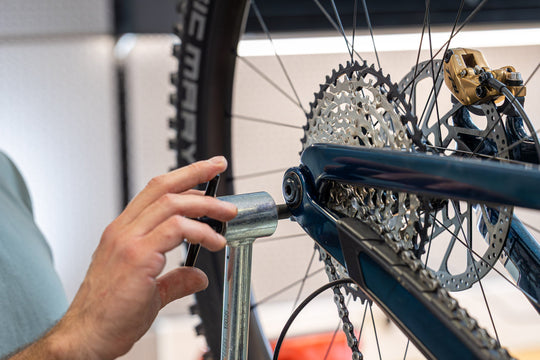
T-handle. A T puts the bolt on the long axis of a balanced two-handed handle. Speed is the gain; you can spin the bolt in and out with one hand on the handle, the shank rolling between your fingers. The compromise is access in tight spots where the cross-bar fouls something nearby. Our T-Handle Hex 193HX is the format.
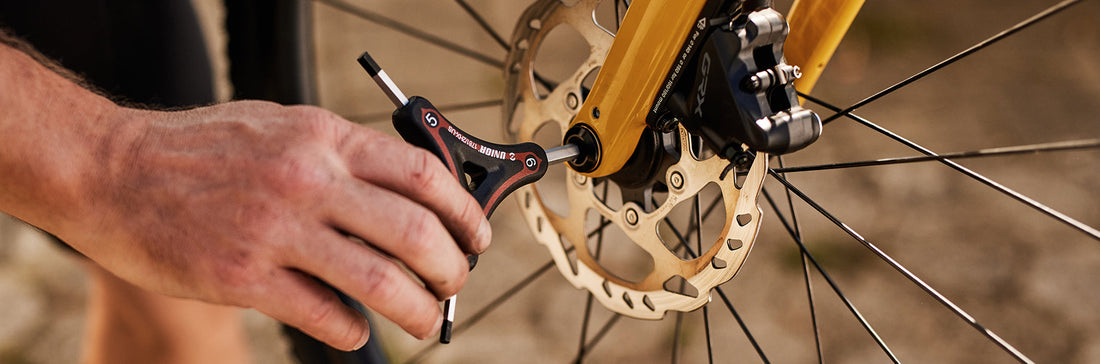
Three-way (Y-handle). Three sizes in one tool, in a Y-pattern that gives you a third axis of leverage. Best for shop work where you reach for the same three sizes in rotation. Our four three-way wrench variants cover the hex span (small, medium, ball-end medium) and the common Torx span (T10/T15/T25).
P-handle. A P-handle is a T-handle with one arm shortened, which clears obstructions a T can't get past. The format shines on rotor-bolt work where a quick-release lever crowds the bolt head. Where Unior offers a P-handle variant for a given size, it's the format we reach for first.
Bit-and-socket sets: when you need a torque wrench in the loop
Hex and Torx bits are the same driver geometry as the L- and T-handles, but cut to a 1/4" or 3/8" or 1/2" square drive end so they fit into a ratchet handle or torque wrench. You need this format any time the manufacturer publishes a torque spec and you want to hit it.
The fasteners that demand a torque wrench in this category: stem face-plate bolts (typically 5 Nm on aluminum bars, lower on carbon depending on the bar's published spec), seatpost binders (varies by frame), crank pinch bolts (Hollowtech II is 12–14 Nm per bolt, SRAM DUB is 8.5–10 Nm; both bands are from manufacturer service manuals), brake-rotor bolts (typically 5–6 Nm per the rotor manufacturer's spec). Our 1/4" Drive Metric Hex Bit set and 1/4" Drive Torx Bit set pair with the Slipper Torque Wrench 2–24 Nm for everything under 24 Nm.
One special case: motor mounting bolts on Bosch Gen4 e-bike drives use the Torx Plus T40 profile, not standard Torx. Standard Torx in a Torx Plus recess will round the bolt under the torque those bolts see. Our 1/2" Torx Plus T40 Socket is the correct tool for that fastener.
Stripping prevention: the failure mode that drives most replacements
Most stripped hex and Torx bolts come from one of three mistakes.
- Wrong size driver. A 5 mm hex turning a 6 mm bolt feels almost-right until you load it; then it rounds. Always test-fit; the driver should drop into the recess without play and seat against the bottom of the recess.
- Ball-end past its working range. Once you're past about 8 Nm of working torque, the ball-end's contact patch starts to deform the recess flats. Switch to straight-tip before you reach for leverage.
- Worn or out-of-tolerance driver. A driver that's been used for years on misaligned engagements develops worn flats. The fit feels loose; the bolt rounds at lower torque than it should.
Our hex wrenches are manufactured to the ISO 2936 dimensional standard for metric hex keys. The standard is the international reference for across-flats dimensions and tolerance bands; a hex key that meets it drops into a correctly-sized recess with no working play.
Building a kit
For a typical home shop covering road, gravel, and MTB maintenance, the kit that gets reached for daily:
- An 8-piece T-handle hex set in the 2–10 mm span.
- A three-way ball-end hex for angled access on stem and cage bolts.
- A long-arm straight-tip set for high-torque pulls.
- A T20/T25/T30 Torx setup (three-way or T-handle) for rotor and chainring work.
- A 1/4" hex bit set on the torque wrench for any fastener with a published spec.
That's the foundation; add P-handles, sockets, and multitools as the work expands.
Heritage
Unior has been forging hand tools in Zreče, Slovenia, since 1919, and sponsors professional road and mountain-bike race teams. The hex and Torx line uses the same chrome-vanadium shanks, black-oxide tip treatment, and trivalent chrome plating to ISO 1456:2009 that Unior's pro-shop tools use; the consumer T-handles and L-keys aren't a downgrade of the pro line, they're cut on the same lines from the same steel.