How to remove a crankset (and pick the right tool)
A workshop guide to crankset removal across the four interfaces you'll meet in service: square taper, splined (ISIS/Octalink), Hollowtech II, and SRAM DUB/GXP. Tooling decisions, the cheat sheet, the gotchas.
On this page
The bike is in the stand, the BB tool is on the bench, and the crank won't come off. Half the time the problem isn't the bottom bracket; it's that the crank you're staring at and the puller you reached for don't speak the same language. There are four common crank interfaces in the modern workshop, plus a couple of legacy outliers. Each one has a removal procedure, and each procedure asks for a different tool.
What kind of crank are you looking at?
Look at the drive-side crankarm where it meets the bottom bracket. Three cues sort almost every crank into the right removal procedure:
- A square hole, plus a 14 mm or 15 mm hex bolt at the centre: square taper. Old standard, still common on entry-tier road, gravel, fitness, and city bikes.
- A splined hole (eight broad splines for Octalink, ten narrow ones for ISIS), plus a centre bolt: splined cartridge BB. Mid-2000s mountain and road; ISIS hung on into early-2010s gravel.
- A round hole the size of the spindle, with two pinch bolts on the non-drive arm and a self-extracting cap on the drive arm: Hollowtech II (Shimano), SRAM DUB, SRAM GXP, FSA Mega Exo, Race Face Cinch, etc. The dominant pattern on mid-tier and up since the late 2000s.
- Something else: Campagnolo Ultra Torque (the two arms join at the spindle midline, no removal cap on the drive side), Cannondale Hollowgram (proprietary spindle nut), older Shimano XTR FC-M970 (proprietary outboard spindle, removed with our 1664 puller).
A note on thread direction. The crank cap on Hollowtech II, DUB, and GXP is left-hand thread on the drive side so it doesn't loosen under pedalling load. The crank itself, after the cap and pinch bolts are off, slides out without rotation. Square-taper and splined cranks pull straight off the spindle along the spindle axis; the puller does the work, not your hands.
Square taper and splined: the crank puller does the work
Square taper and splined (ISIS, Octalink) cranks share a removal procedure even though the spindle interfaces look different. Both pull straight off a tapered or splined spindle, and both use a crank puller: a two-piece tool that threads into the crank arm's puller threads, then drives a centre rod against the spindle to push the crank away.
The procedure:
- Remove the centre crank bolt with the right wrench. Square-taper bolts are usually 14 mm or 15 mm hex; splined and Octalink bolts are usually 8 mm hex.
- Look for the dust cap. Some square-taper cranks have a small plastic or aluminium dust cap covering the puller threads; pry or unscrew it before threading in the puller. Pulling against an unthreaded crank arm strips the threads.
- Thread the puller body into the crank arm's puller threads. Hand-tight, then snug with a wrench. Use the splined adapter for ISIS and Octalink; use the square-taper face for square taper.
- Turn the puller's centre rod clockwise. The rod presses against the spindle and pushes the crank arm outward along the spindle axis. The crank releases with a definite pop.
The most common failure on a stuck crank is rounded or stripped puller threads in the crank arm; usually because someone tried to pull a square-taper crank without removing the dust cap, or because they reused a puller with a worn centre rod. Our 1662/4 Square Taper Crank Puller has tapered puller threads designed to grip damaged threads where a straight-thread puller would skate. If a stuck crank is the situation in the workshop today, that's the puller to reach for.
Hollowtech II, SRAM DUB, GXP: pinch bolts plus cap
The modern through-spindle pattern keeps the crank assembly together with two pinch bolts on the non-drive arm and a self-extracting plastic or aluminium cap on the drive arm. Removal is mechanically simpler than crank-puller work; the cap does the puller's job.
The procedure:
- Loosen the two non-drive-side pinch bolts. They're usually 5 mm hex; back them off two or three full turns. Don't remove them entirely; the bolts hold the arm captive against the spindle clamp.
- Unscrew the drive-side crank cap. The cap is left-hand thread. Use a Hollowtech II cap tool (we make the 1609.1 Hollowtech II Crank Bolt Tool for Shimano caps) or the Crank Cap Tool for SRAM DUB for SRAM DUB. The cap rotates a few turns and then the captive bolt under it pushes the spindle outward.
- Slide the non-drive arm off the spindle. With the cap removed and the pinch bolts loose, the crank arm comes off in a straight pull.
- From the drive side, the spindle and drive-side arm now slide out of the bottom bracket as a unit. With the crank off, the bottom bracket is exposed, so if it is noisy or overdue for service, here is how to clean or replace a Hollowtech II bottom bracket.
Two cap-tool gotchas worth flagging. First, the cap tool's pin engagement is fiddly; if the pins aren't seated all the way down before turning, they slip out under torque and round off the cap's drive holes. Press the tool firmly down before applying any rotation. Second, the cap is plastic on most Shimano and SRAM tiers, and over-tightening on reinstall (anything past about 0.5 Nm) deforms the cap. The cap is a preload device, not a structural fastener; finger-tight plus a quarter turn is the right feel.
The cheat sheet
| Crank interface | Removal tool | Tool SKU | Notes |
|---|---|---|---|
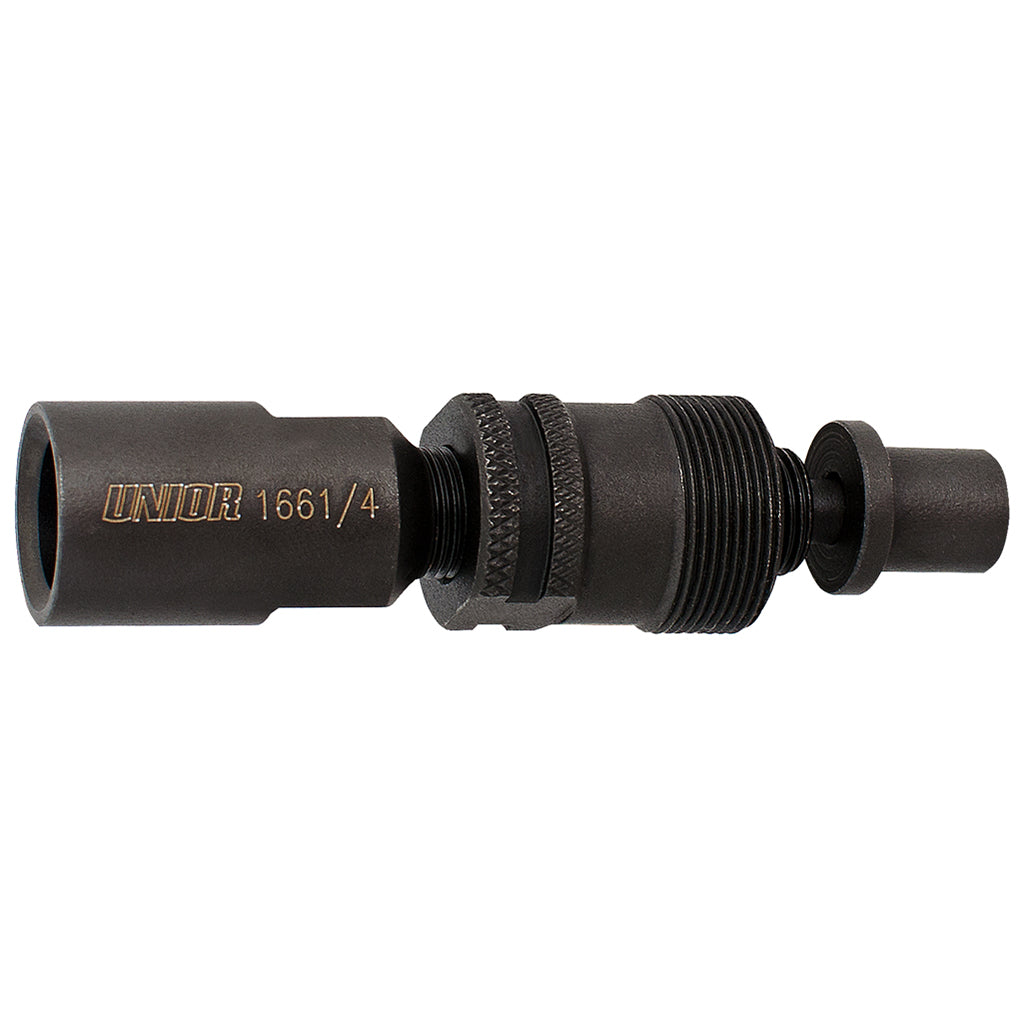
| Square taper (modern) | Crank puller, square-taper face | 1662/4 or 1661/4 | 1661/4 includes a splined adapter for ISIS/Octalink |
| Square taper + splined (one tool) | Combined puller with handle | 1661.3/4P-US | 6.5″ handle, no separate wrench needed |
| ISIS Drive | Crank puller, splined adapter | 1661/4 | Shares the 1661/4 with square taper via included adapter |
| Shimano Octalink | Crank puller, splined adapter | 1661/4 | Same procedure as ISIS |
| Shimano XTR FC-M970 | Proprietary puller | 1664 | Outboard spindle nut, four-pin engagement |
| Hollowtech II (Shimano) | Cap tool + 5 mm hex | 1609.1 | 8 mm hex in the centre for stuck caps |
| SRAM DUB | DUB-specific cap tool + 5 mm hex | Crank Cap Tool for SRAM DUB | Pin-engagement pattern, not splined |
| SRAM GXP | Hollowtech II cap tool fits | 1609.1 | GXP cap engages on the same splines as HT2 |
Stuck crank? Damaged threads?
The most common workshop call on a square-taper or splined crank is “the puller threads are stripped.” It's usually true. Two things to try before you give up:
The first is the 1662/4 Square Taper Crank Puller. The puller threads are tapered, so they grip threads that have started to give up on a straight-thread puller. We've pulled cranks off with the 1662/4 that the previous mechanic had given up on with a generic puller.
The second is the Crank Saver Kit (1695MB1-US). When the pedal threads in the crank arm are gone but the rest of the arm is fine, its reaming taps cut an oversize seat and a steel insert threads in with strong thread locker, restoring the standard 9/16″ × 20 pedal thread. It repairs pedal threads, not the puller threads; our stripped pedal threads guide walks the full procedure.
For Hollowtech II and DUB, “stuck” usually means the cap is over-torqued or the pinch bolts haven't been backed off enough. Walk the diagnosis backwards: cap tool pins fully seated, pinch bolts loose enough that the arm wiggles by hand on the spindle, then re-engage the cap. The arm comes off without resistance once the spindle is free of the bottom bracket clamp.
Reinstalling: the part nobody talks about
Square taper and splined cranks reinstall under torque to a manufacturer-specified spec, usually 35–50 Nm for square taper, 40–50 Nm for ISIS/Octalink. The bolt is what compresses the crank arm onto the spindle taper or splines; under-torquing leaves the arm able to creep loose and chew up the interface. Use a torque wrench.
Hollowtech II, DUB, and GXP cranks reinstall in two stages. The cap is preload: finger-tight plus a quarter turn (about 0.5–0.7 Nm, far less than feels right). Then the pinch bolts torque to spec; Shimano calls for 12–14 Nm, SRAM calls for 8.5–10 Nm for DUB. The pinch bolts are the structural fastener; the cap just sets the bearing preload.
One last shop trick
If the puller is slipping on a square-taper crank arm, the threads are usually fine. The cause is the centre rod losing purchase on a dirty spindle face. Wipe the spindle face with a clean rag before threading the puller in. The rod needs flat steel to push against, not the residue of last winter's grit.
The crank-puller body in our shop is the Crank Puller for Splined and Square Taper (1661/4); the included splined adapter covers ISIS and Octalink off the same body, and the 14 mm hex socket on the opposite end pulls double duty as the crank-bolt removal wrench. For Hollowtech II and SRAM GXP cap work, the 1609.1 Hollowtech II Crank Bolt Tool is the cap tool; for SRAM DUB it's the Crank Cap Tool for SRAM DUB. When the pedal threads in a crank arm have already given up, the Crank Saver Kit (1695MB1-US) is the reaming-and-insert salvage kit that turns a thrown-away arm into one that takes a standard pedal again.
Unior has been forging hand tools in Zreče since 1919, and sponsors professional road and mountain-bike race teams. The crank pullers in this article are drop-forged from premium flex plus carbon steel, hardened and tempered, then chrome-plated to ISO 1456:2009. The Crank Saver Kit packages the reaming taps and thread inserts that turn a stripped-thread crank from a write-off into a repair.