Servicing an e-bike: what's different from an analog bike
An e-bike isn't just a bicycle with a motor; service is different in three concrete ways. We cover the weight and the workstand, the live-electrical safety question, and motor-specific tooling like the Shimano STEPS chainring lockring.
On this page
Most of the e-bikes that come into our shop don't ask for anything exotic. Brake pads wear, cables stretch, derailleurs go out of index, the same as any analog bike. The difference shows up in three specific places: the bike is heavier and torques harder, there's a battery and a motor harness that don't appreciate a stray screwdriver, and the motor uses some fasteners you won't find anywhere else on the bike. Plan a workshop around those three differences and the rest of e-bike service is exactly as boring as it should be.
This guide walks through what changes about the setup. We'll cover the stand and the workstation around it, where insulated tools earn their keep, and the motor-side service that calls for a dedicated lockring tool. Each section names the parts of the Unior catalog that map to that piece of the setup.
What's different, in one minute
Three real differences, in plain terms:
- The bike weighs more, and the weight is in the middle. A mid-drive e-MTB on the stand routinely runs two to three times what a road bike does, and cargo e-bikes loaded with kit can run heavier still; nearly all of the extra mass clusters around the bottom bracket. A repair stand that handles it without flexing or creeping is worth the line item.
- There's live electrical near where you work. The battery delivers high voltage to a motor harness that runs along the downtube; the motor itself has terminals inside. Pulling the battery before service is the right first step. For everything beyond that, insulated tools are the difference between a routine job and a story you don't want to tell.
- The motor has fasteners that aren't on any analog bike. The most common one is the chainring lockring on Shimano STEPS drive units. Generic cassette and BB tools don't fit it; the right tool is a single SKU you keep on the bench.
The rest of the article digs into each of these. The setup recommendations all use parts of the Unior E-Bike Tools collection.
The lift: a stand built for the extra weight
The first time you put a 55 lb e-MTB onto a stand designed for road bikes, you feel it. The clamp slips under the top tube load, the column flexes when you spin the rear wheel, and lifting the bike to working height stops being a one-handed move. Most shop stands handle the load (just barely), but the working comfort degrades fast.
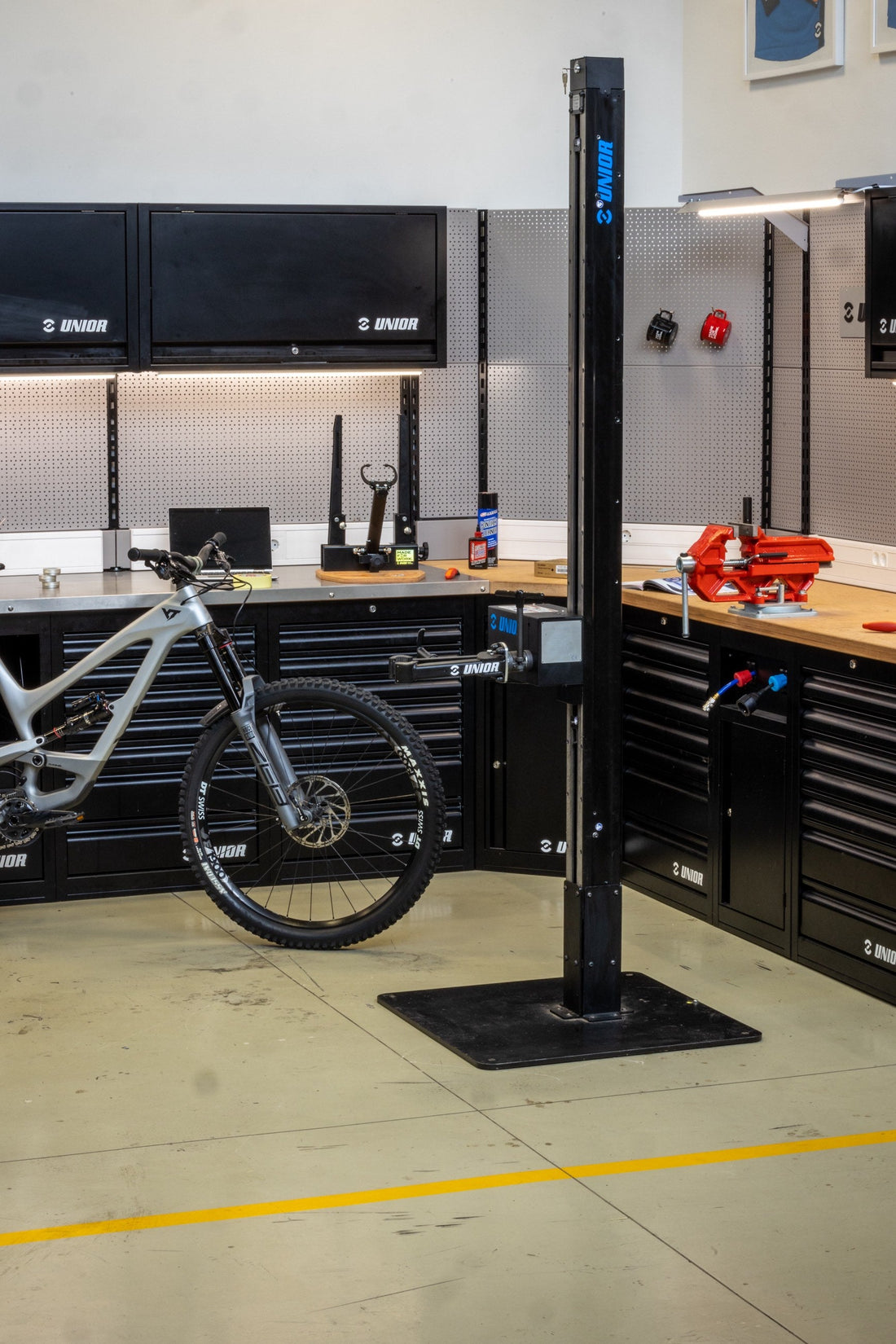
Unior's Electric Repair Stand 1693EL is the answer to this on the workbench side. It's a powered-lift stand that drops the bike to floor height for wheel-out work and lifts it back to comfortable bench height with the press of a button. The lift motor takes the weight question off the table; the same stand handles a road bike and a cargo e-bike without complaint, and the operator's back is happier for it.
The stand has two mounting options. The standard rolling base lets you reposition for parts unloading or photography. For shops that want the stand fixed in one location, the Fixed Plate accessory for the 1693EL bolts the column to the floor. It's a single product purchase that converts a portable stand into a fixed-bay tool, particularly useful when adding the electric lift's wired control panel to a permanent service-bay layout.
The workstation: keeping the work surface around the bike
The lift solves the weight question. The accessories solve everything that comes after: the diagnostic laptop, the service manual on a tablet, the parts you don't want to walk back to the bench for, the tools you reach for over and over during a single job. The Unior 1693EL accessory range mounts directly to the stand column so the work surface follows the bike as you lift and lower it.
Two design choices repeat across the accessory range, and they matter when you're picking what to buy. The folding versions ride on a 500 mm articulated arm; you pull them over the bike when you're using them and fold them out of the way when you're not. They're the right call for shared workspaces or any bay that doubles as something else half the day. The fixed versions mount directly to the column, sit closer to the stand, and stay put. They're the right call for dedicated e-bike service bays where the same workflow runs all day.
For laptop and tablet work (manufacturer diagnostic software, service-manual PDFs, firmware updates), the Folding Laptop Holder 1693EL.2 accepts laptops up to 15″ on its rotating tray. The Tablet Holder 1693EL.6 takes tablets from 210 mm to 340 mm wide and mounts at a 67° angle that matches how you'd hold the tablet to read it.
For small parts (washers, spacers, the bolts you took out three minutes ago and don't want to lose), the Folding Small Parts Organizer 1693EL.3 and the Fixed Small Parts Mount 1693EL.9 both accept the plastic boxes from the Unior range. The folding version pulls out over the bike when you need it; the fixed version sits permanently to one side.
For working tools (the screwdrivers, hex keys, and pliers you cycle through during a job), the Folding Tool Tray 1693EL.5 and the Fixed Tool Tray 1693EL.7 both pair a thin metal plate with SOS foam slots that hold drivers upright and keep bits from rolling off. (Note: the Fixed Tool Tray 1693EL.7 is specified for V1 stands only; check your stand version against the accessory before ordering.)
For the operator who wants to work the lift hands-free, the Remote Control 1693EL.20 puts the lift controls on a coded wireless remote you can keep on the bench. It's V2-stand only (April 2021 onward) and installs in a few minutes without pairing.
The battery and the motor harness: insulated tools
The right first move on any non-trivial e-bike service is to pull the battery and let the system de-energize. Once the battery is out, the bike is almost back to the analog case. Almost.
There's still a motor harness running through the frame and bare terminal pads on connectors that you can touch with a probe or a driver tip. Most of the work you'd do without an insulated tool is fine; the work that isn't fine (diagnosing a short across a connector with the battery in, probing a sensor lead while looking for a fault, removing a motor cover with the harness still attached) is the small percentage of e-bike service where insulated tools matter.
Unior's electrician's line carries VDE certification; the same approval mark European electrical trades look for on hand tools used near live circuits. The certification is what makes a driver safe to use on a connector you can't fully confirm is dead. The insulation runs up the blade to within a few millimeters of the working tip, and the certification mark is printed on each tool body.
The four insulated tools in the collection cover the common e-bike electrical jobs:
- The Diagonal Cutting Nippers 461/1VDEBI handle wire-loom and zip-tie work near the harness.
- The Electrician's Screwdriver VDE/TBI is the small driver for terminal-block fasteners and connector-cover screws.
- The Flat Bladed Screwdriver 603VDETBI is the workshop standard flat-blade with the VDE insulation added.
- The Phillips Screwdriver 613VDETBI is the same workshop standard in cross-tip form for the Phillips fasteners that secure most motor covers and display housings.
We keep these four within reach of the e-bike bay and treat them as the first option for any work where the answer to “is everything de-energized?” is anything other than a clean yes.
Servicing the motor: the chainring lockring
The other category of work that's unique to e-bikes is anything that comes off the motor. Most service stays clear of the motor internals (those usually go back to the dealer), but the chainring lockring is the boundary the home and shop mechanic crosses regularly. Replace a worn chainring, fit a different tooth count, or change a spider on a Shimano STEPS drive and you're working on the lockring that holds the chainring to the motor spindle.
Shimano's OEM tool for the job is the TL-FC39. Unior's equivalent is the Shimano STEPS Lockring Tool 1724.SSL, which fits the E6100, E7000, E8000, E9000, and EP8 drive units. The tool is CNC-machined aluminum, anodized red for visibility on a crowded bench, and pairs with a 1725/CF Crowfoot adapter and a 1/2″ drive torque wrench so you can finish the install at Shimano's specified torque rather than guessing.
If your shop only services non-Shimano mid-drives, this isn't your tool; those motor brands use different fasteners and need their own lockring tools. Shimano STEPS, however, is one of the most common mid-drive systems on retail e-bikes we see on the stand, and the lockring tool earns its drawer space in any shop that takes those bikes.
Starter setup checklist
Working backwards from the three differences, here's the minimum e-bike-specific kit:
| What it's for | Tools |
|---|---|
| Holding the bike | Repair stand that handles cargo-e-bike weight without flex (Unior 1693EL is our default) |
| Working surface around the bike | At minimum one tray for tools and one parts bin; tablet or laptop mount if you run diagnostics |
| Live-electrical work | Four-tool VDE-insulated kit (side cutters, two screwdrivers, electrician's driver) |
| Motor service | Shimano STEPS Lockring Tool 1724.SSL (Shimano-equipped bikes); add others as your bike mix demands |
The analog-bike tooling you already own does the rest. The chain, the brakes, the cables, the spokes, the bearings; those are the same jobs they always were. E-bike service is the analog-bike service you know with three small additions made by a stand that lifts the weight for you, four tools that don't conduct, and one lockring tool you'll be glad is in the drawer the first time you need it.