

Go/no-go is the whole interface: lay the gauge across two links, and a chain inside tolerance holds it out while a worn one lets it drop at the 0.7% mark. That legacy threshold suits 6- to 10-speed drivetrains; narrow 11-, 12-, and 13-speed chains need the earlier 0.5% call, which is the dual-threshold 1644/6's job.
In stock
Couldn't load pickup availability
Free US shipping on orders $75+
Some exceptions apply — see shipping policy
Forged in Zreče, Slovenia since 1919. Sponsors professional road and mountain-bike race teams.
View full details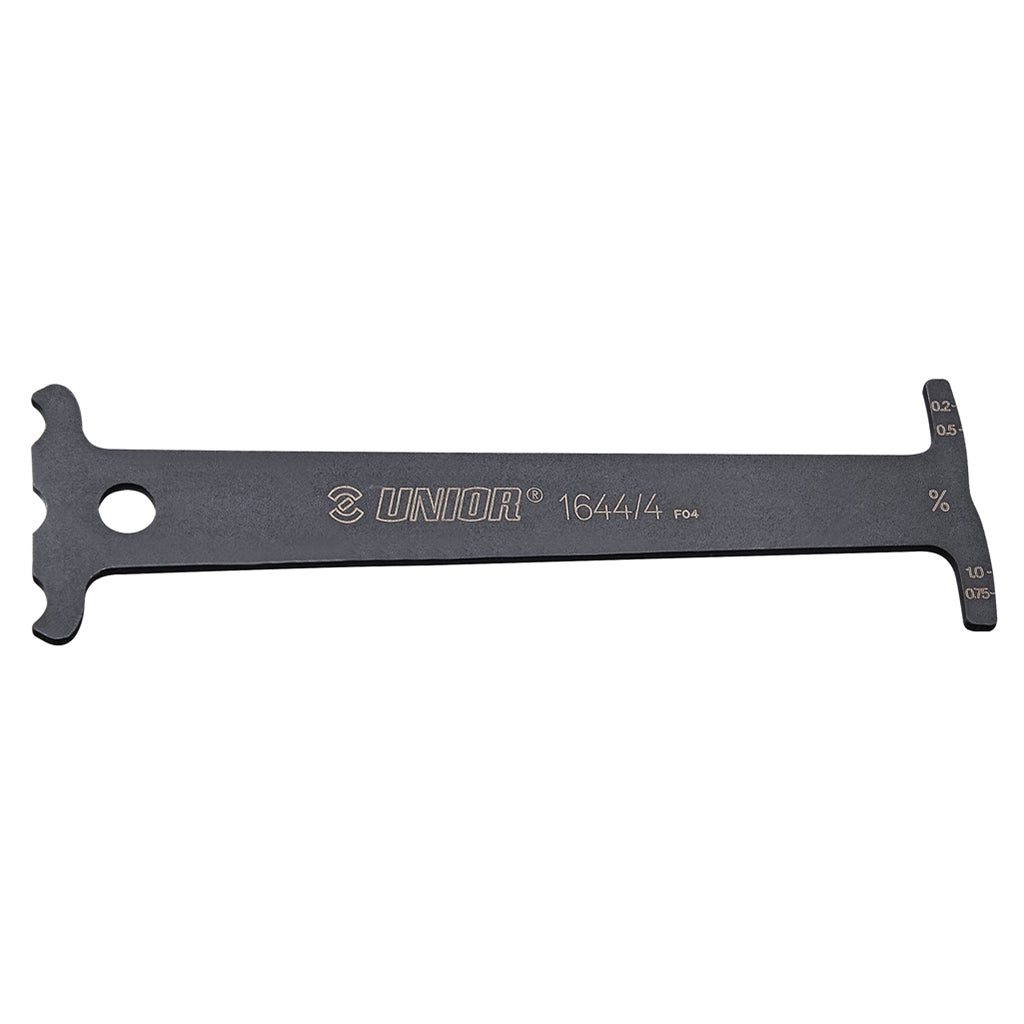
On this page
A go/no-go gauge gives one answer: it fits, or it doesn't. The Manual Chain Wear Indicator 1644/2 is the cycling version of that workshop standard. Drop it across two links of a chain, push down, and the chain either holds it or lets it drop. Holds it, the chain is still inside service tolerance. Drops, the chain needs replacing.
There's no dial, no electronic reading, no calibration to wonder about. The 1644/2 is a flat piece of laser-cut steel with two reference faces, each cut to a published tolerance. It's the simplest answer to “is this chain done.”
How to read it
Two zones are stamped on the tool:
- 0 to 0.6% is the no-wear side. If the gauge sits without dropping in on this end, the chain is still inside its service window.
- 0.7% to 1.2% is the wear side. If the gauge drops in here, the chain is past replacement and the cassette teeth are next in line.
The decision is binary. There's no in-between reading to second-guess.
When this is the right call
The 0.7% replacement trigger is the legacy chain-wear convention. It's accurate for 6- through 10-speed drivetrains, where wider cog spacing gives the chain a little more room before deformation cascades into the cassette.
Modern 11-, 12-, and 13-speed chains want a tighter call. Current chain-maker guidance is to swap a narrow-spaced chain at or before 0.5%, and the 1644/2's drop-over only triggers at 0.7%. On those drivetrains, the Chain Wear Indicator 1644/6 reads both 0.5% and 0.75% directly and is the right tool for the speed.
Where the 1644/2 still earns its space is on the older bikes, in the home toolkit that needs to be cheap and small enough to live in a drawer, and as the second gauge on a shop bench that's already running a more granular reader.
Specs
- 122.5 × 37 × 2 mm (with a 12.7 mm reference length for pin-to-pin spacing)
- 40 g
- Precision laser-cut steel
- Go/no-go reading at 0.7% replacement threshold
- Lifetime warranty
- Article number: 1644/2
Built in Zreče, Slovenia
Unior has been forging hand tools in Zreče since 1919, and sponsors professional road and mountain-bike race teams. The 1644/2 is the entry-level chain-wear tool in the catalog, and the design reflects what the workshop standard quality-assurance gauge has always been: a known reference shape that either fits or doesn't, ground to a tolerance the user can trust. The cheap version of that gauge is a Popsicle stick with two notches scratched into it. This one is laser-cut steel.
Pro tip from our mechanics
A go/no-go reading doesn't tell you when the chain crossed the line, only that it has. Our chain-replacement guide explains what's happening on the cassette teeth between the two readings the 1644/2 won't separate, why the 0.5% versus 0.75% distinction matters once you know which drivetrain you're on, and how to plan a new chain in before the cassette pays for the delay: When and how to replace your chain →
FAQ
What counts as excessive wear on a bike chain? Elongation past the replacement threshold. On the 1644/2's wear side, marked 0.7% to 1.2%, a chain that lets the gauge drop in is overdue for replacement; the cassette teeth take the damage next.
Which drivetrains suit the 1644/2's 0.7% replacement threshold? The 0.7% trigger is the legacy convention and stays right for 6- through 10-speed drivetrains, whose wider cog spacing tolerates more elongation before the cassette suffers. Chains for 11-speed and up, 12- and 13-speed included, should be swapped at or before 0.5%, a reading the Chain Wear Indicator 1644/6 makes directly on its body.
Does the Manual Chain Wear Indicator need calibrating? No. It's a flat gauge in laser-cut steel whose two reference faces are cut to published tolerances; there's no dial or electronic reading to drift, and the tool carries a lifetime warranty.
 Tech Tips
When and how to replace your chain
Tech Tips
When and how to replace your chain
