
In stock
Couldn't load pickup availability
Forged in Zreče, Slovenia since 1919. Official technical partner of multiple World Tour and downhill teams.
View full details
On this page
The decision to wear gloves in a bike shop is a workflow question, not a comfort one. Bare hands get the best feedback on torque and feel but pay for it across the week: brake-pad-compound dust on the fingertips, chain lube residue under the nails, parts-cleaner-saturated cuts that don’t heal until the weekend, and the recurring salt-and-corrosion under handlebar tape on neglected bikes. A good nitrile glove is the in-between answer: thick enough to survive a full service ticket, thin enough to keep hand feel intact, latex-free for the small percentage of mechanics allergic to latex.
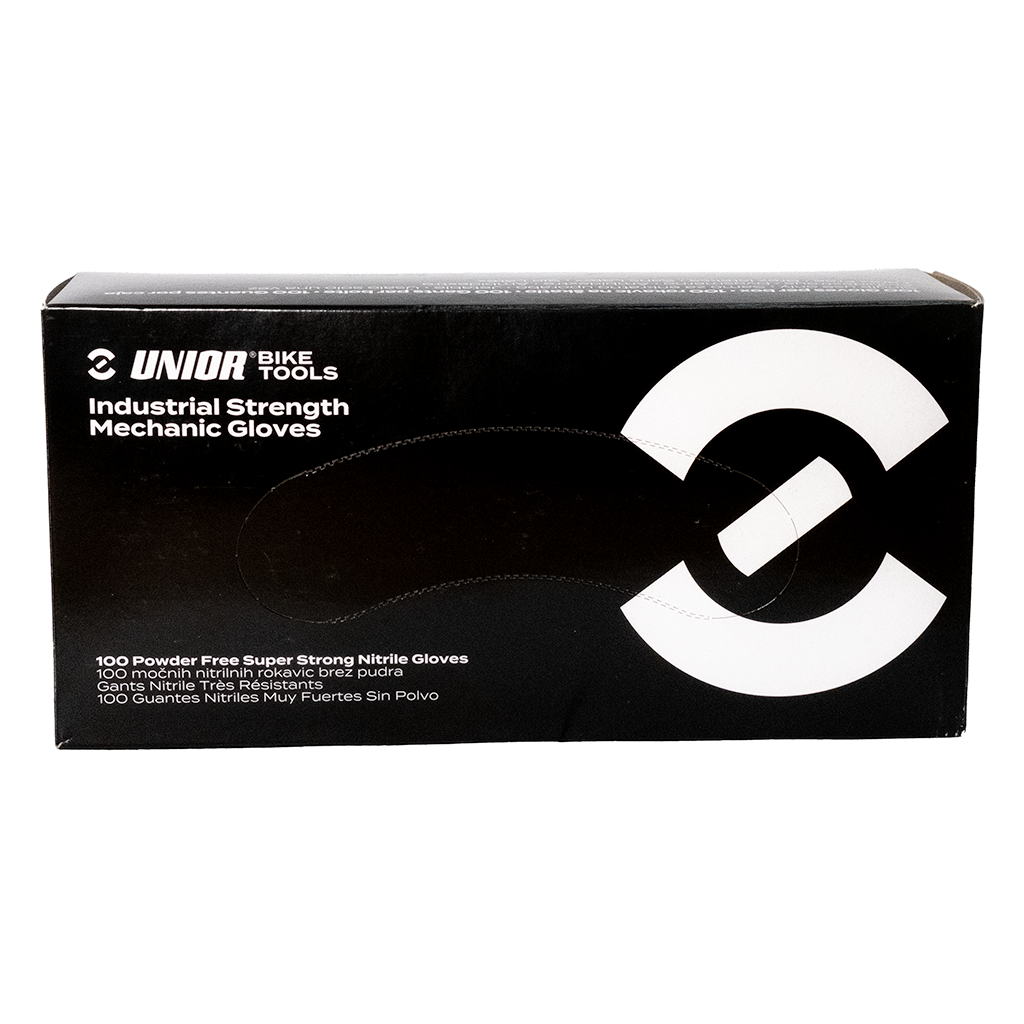
The Unior Industrial Strength Nitrile Mechanic Gloves are the same gloves we’ve been selling as “Black Mamba” for years; re-branded with our packaging. The same 6 mil heavy-duty nitrile, the same latex-free construction, the same chemical resistance against oils, cleansers, sealants, and the everyday workshop muck that gets between a mechanic and their work.
Specs
- Material: nitrile (latex-free); no latex allergy risk.
- Thickness: 6 mil heavy-duty.
- Quantity per box: 50 pairs.
- Available sizes: 4 sizes covering the range that fits most adult hands.
What they survive
- Oils; chain lube, fork oil, suspension oil, light greases.
- Cleansers; degreaser, parts cleaner, citrus-based degreasers.
- Sealants; silicone-based, anaerobic thread-locker, polyurethane.
- Road and trail muck; the grit, grime, and dirt that bikes return from rides covered in.
- Salt-and-corrosion residue; the corrosive crust that forms under handlebar tape on neglected bikes, ridden in winter conditions.
Why these glove cost more
The 6 mil construction is heavier than the everyday 3-4 mil nitrile glove found at consumer hardware stores. Two implications:
- Tear resistance is higher; a 6 mil glove survives a full chain replacement and a wheel truing in one pair; the lighter 3-4 mil gloves tend to wear through partway through a service.
- Per-pair cost is higher; per-service cost is lower. A 6 mil glove that survives two full services saves more money in glove count than the per-pair price difference; per-service, the heavier glove is cheaper.
The trade-off lives in hand feel: a 6 mil glove damps torque feedback slightly more than a 3-4 mil glove. For most bench work the trade-off is favorable; for fine-feel work (carbon-bar installs, suspension teardown) some mechanics still prefer bare hands or a thinner glove.
Where they earn their place
Three workshop workflows where the 6 mil glove pays back:
- Drivetrain service; chains, cassettes, cranks, BBs all involve grease and grime that the glove keeps off the mechanic’s hands.
- Brake service; brake fluid (DOT and mineral) is toxic to skin; brake-pad compound dust is also worth keeping off the hands.
- Suspension service; fork oil and damper oil; parts-cleaner contact.
Built in Slovenia (packaging)
These gloves are not Unior corporate manufacturing; they’re packaged for the Unior USA distribution. Unior has been forging hand tools in Zreče, Slovenia, since 1919, and is the official technical partner of multiple World Tour and downhill teams; gloves are part of the consumables line that supports the tools, not part of the hand-tool manufacturing line itself.
Pro tip from our mechanics
A box of 50 pairs lasts a single-mechanic shop about a month at one-glove-pair-per-service, or about two weeks at one-glove-per-bike-and-discard. Most shops settle on a one-pair-per-shift workflow for the dirty work plus bare hands for the precision work. Our broader workshop-setup guide covers consumable-supply planning: How to set up a professional bike workshop →
