How to set up a professional bike workshop
A workshop is a workflow problem before it is a tool problem. Bench placement, repair-stand choice, and a find-it-in-five-seconds tool system decide how many bikes a mechanic can turn around in a day.
On this page
- Zone the floor before buying anything
- Pick the workbench before the cabinet
- Tool storage: the find-it-in-five-seconds rule
- Repair stands: fixed, mobile, or electric
- Tool sets: when a set beats individual tools
- Suspension and e-bike: the wet-zone exception
- Ergonomics: the cost the bench mechanic pays
- Cheat sheet: what to buy in what order
A workshop is a workflow problem before it is a tool problem. The decisions that decide how many bikes a mechanic turns around in a day are the boring ones: where the bench sits relative to the door, how far the most-used tool travels from drawer to hand, whether the repair stand parks every bike at the same working height. The tools sit on top of that decision tree, not under it.
This guide is the framing we use in our own shop, and the one we sketch out for shops upgrading from a converted-garage layout to a service-center floor. Specific Unior products show up where they map cleanly to a decision; the underlying principles are tool-agnostic.
Zone the floor before buying anything
Pick the side of the room that takes incoming bikes first. That side is the receiving zone, where the work order gets opened, the bike gets weighed in, and the keys go into a tracked rack. From there the floor wants three things, in this order: a repair zone (stands plus benches), a wheel zone (truing, building, washing), and a suspension or e-bike zone if the shop services either. The aisle between them stays clear; bikes move on stands, not on the floor.
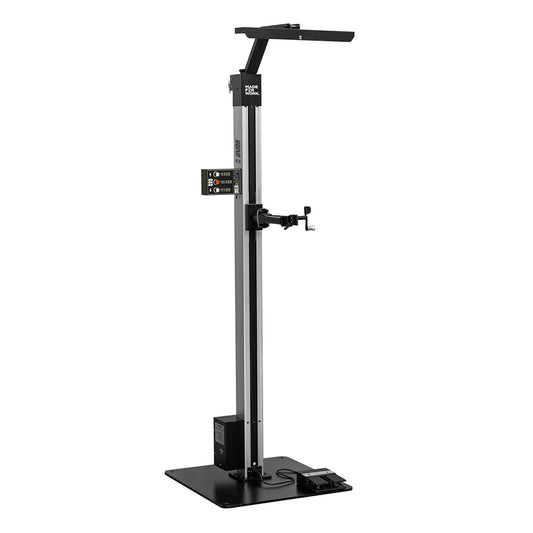
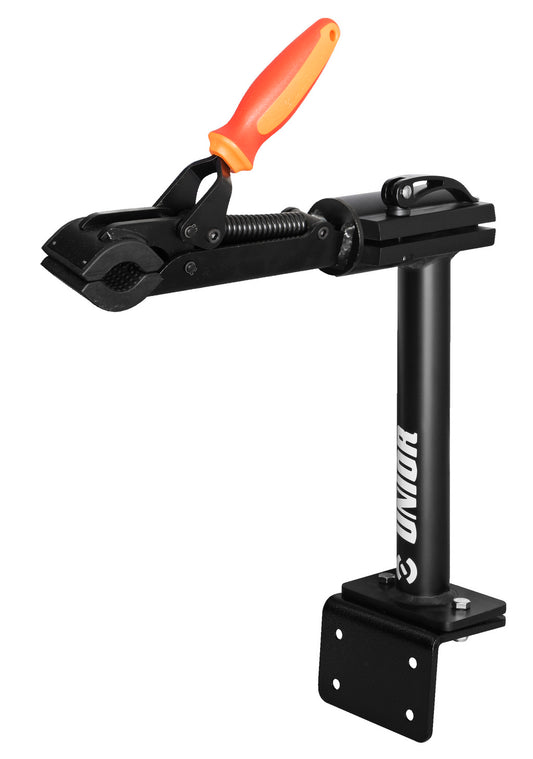
The repair zone is where the bench-to-stand distance matters most. A bench-mounted clamp like the Wall / Bench Mount Clamp 1693.2-US keeps a small-parts station within arm’s reach of a parked bike; for shops that prefer a free-standing stand, the Electric Repair Stand 2.0 brings the bike to the mechanic rather than the other way around. The choice is between bringing the parts to the bike and bringing the bike to the parts. Both work; one of them won’t fit your floor.
Pick the workbench before the cabinet
Workbenches are the slowest thing in the shop to change. Once a 2-meter steel-frame bench is wired in, sunk into the floor through levelers, and topped with a tool chest, it lives there until the lease ends. So the order is bench first, storage second.
Three tiers cover most shops:
-
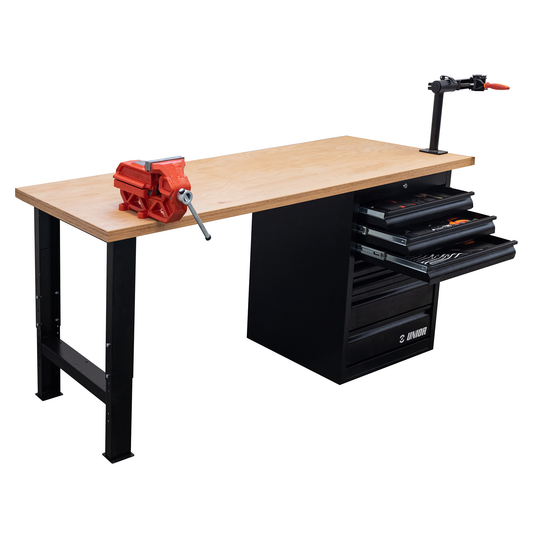
Single-mechanic shop, mixed work. A free-standing bench like the Unior 2600A Professional Mechanic Workbench integrates one 7-drawer chest into a 2 m × 75 cm working surface with a 1000 kg capacity. It is the bench shape that fits inside a single garage bay or a dedicated workshop nook without an architectural change.
-
Multi-mechanic shop, high-volume. Two or more chest-integrated stations or the Unior 2600C Master Workbench, which carries every Unior bike tool plus two integrated 990WD7 cabinets. The Master Workbench’s footprint and tool count assume the shop is paid to keep more than one mechanic working; for a single-mechanic shop, half the SKUs sit unused.
-
Suspension or e-bike specialty bench. The Suspension Workbench 2600D-US and the matching Stainless Steel Suspension Sink 990SIN form a wet-bench station for fork and shock service. Oil, solvent, and dust are the constraints; the stainless surface and integrated drain are what keep that work off the main repair bench.
For modular layouts that grow over time, the Adjustable Leg 990LA-US, Workbench Back Panels 990B, Back Panel Supports 990SL, and Cabinet Risers 990WDU are the components that connect a small starter bench to a multi-station run. The modular path costs more piece-by-piece than a fixed bench, but a shop expanding from one mechanic to three doesn’t have to tear out and re-pour.
Tool storage: the find-it-in-five-seconds rule
We measure tool storage by how long a mechanic spends looking. Anything past five seconds is a tax on every job, paid every time. Two tool systems carry that load in our experience: foam-tray inserts in shallow drawers, and a vertical rack on the bench back for the dozen tools a mechanic touches every hour.
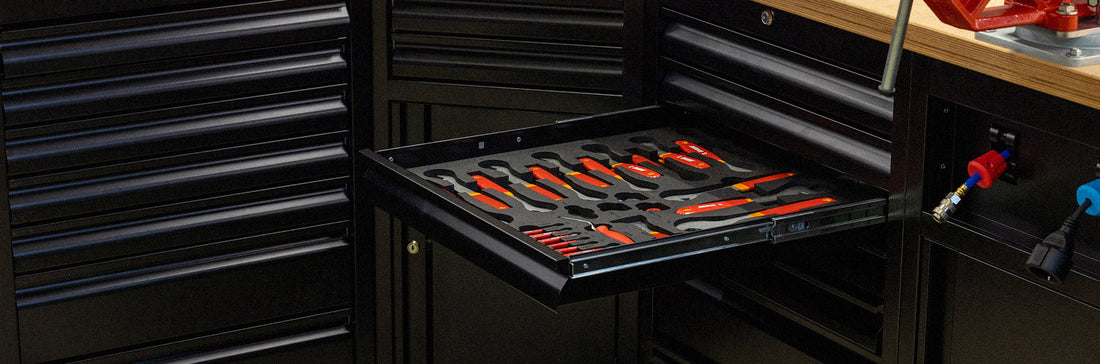
The Unior SOS foam tray system is the foam-insert version. Each tray is laser-cut to the silhouette of the tool it holds, so a missing tool is visible at a glance; the absence shows up as foam, not as a hopeful “I’ll find it later.” A seven-tray SOS set in a 2600A/2600C bench groups tools by service category (drivetrain in one tray, wheel tools in another, torque tools in a third), so a mechanic working on a cassette swap pulls one tray to the bench, finishes the job, and slides it back. Tools don’t migrate.
The vertical rack lives on the Eurostyle Tool Carriage 940E4/1L or the Hercules Tool Carriage 940H2 for the rolling version. Shops that prefer fixed storage put the daily-driver tools on a Tool Cabinet 949 and the long-term storage in a Heavy Duty Parts Cabinet 991HD. The split between daily and weekly tools is the one that decides whether a mechanic walks across the shop ten times a day or zero.
Repair stands: fixed, mobile, or electric
Stands are a three-way choice, not a two-way one.
- Fixed bench-mounted clamps like the 1693.2-US live on a bench corner and don’t move. They’re the right pick for the small-parts station (the place where a wheel comes off a bike and a derailleur gets cleaned) because the bench surface is already there and the clamp doesn’t take floor space.
- Free-standing manual stands are the workshop default. The Floor Stand 1693H is the in-shop bike-display version; full pro repair stands roll up to a bike, lock down, and stay put through a service.
- Electric stands like the Electric Repair Stand 2.0 lift a 70 kg bike to mechanic-eye height with a push of a button. The work case is high-volume shops, e-bikes (60 to 70 kg fully-built is common), and shops that service riders with bikes the mechanic can’t lift to working height by hand. The cost is a wired floor and a control panel; the benefit is fewer back issues across the bench mechanics’ careers.
A shop with three repair zones often runs all three: a fixed bench-clamp at the parts station, two manual stands at the main repair zone, and one electric stand for e-bikes and the high-volume zone. The electric replaces a single manual stand, not all of them.
Tool sets: when a set beats individual tools
Most shops buy individual tools as they need them. The exception: a new shop equipping for the first time, or a shop standing up a new service category. There, a tool set in a foam tray gets the shop to “ready to take work” in a single purchase, and the tray system enforces the find-it-in-five-seconds rule from day one. Several Unior sets are designed around this:
- The bench-integrated drawer sets: tray 2 drivetrain tools, tray 3 wheel tools, and tray 4 torque tools and pliers for the 2600A/2600C bench platform.
- The 1600SOS21–27 series of modular tool-tray groupings sized for in-shop daily work: Hanger Alignment & Cable Pliers, Sockets, Ratchets & Torque Wrench, Cone Wrenches, Crank, Cassette & Freewheel Tools, Bottom Bracket, Spoke & Brake Tools, and Hex/Torx T-Handles & Screwdrivers.
Tool sets don’t replace individual tool purchases; they replace the first-purchase decision tree. A shop ordering 30 tools individually for opening day spends the equivalent of three weeks evaluating each line item. A foam-tray set compresses that into a single decision.
Suspension and e-bike: the wet-zone exception
Suspension service is the one workflow that doesn’t share a bench with the rest of the shop. Oil, parts cleaner, and dust shells from worn seals contaminate the main repair bench within a week of being asked to do double-duty. The standard layout puts suspension on its own bench (a Suspension Workbench 2600D-US) with its own stainless sink plumbed to a separator-tank drain.
E-bike service overlaps with suspension in the cleaning-and-degreasing step but diverges at the motor. Most mid-drive motor service stays at the main repair bench; the wet-zone tools (degreaser bath, parts washer, ultrasonic cleaner) live at the suspension station. A shop that picks up e-bike service after standing up suspension typically extends the wet zone before extending the dry one.
Ergonomics: the cost the bench mechanic pays
A shop bench sits at a height that the bench-buying mechanic picked when they were young, and every other mechanic who works at that bench inherits the choice. The Unior workbench tops sit at 91 cm; the Bicycle Display Stand 1693H parks bikes at the seat-tube-grab height a mechanic standing flat-footed reaches comfortably. Adjusting one bench up by 5 cm to fit a tall mechanic shifts the next-mechanic-down’s posture; either accept that or buy a second bench at a second height.
The two ergonomic interventions that pay back fastest in a multi-mechanic shop are an electric stand for the long-day mechanic (lift the bike to their height, not their back to the bike) and an anti-fatigue mat at the main repair zone (the wooden angle working plate is dual-duty: a stainless cover layer over a wooden core, which damps a dropped wrench better than a steel plate alone).
Cheat sheet: what to buy in what order
For a shop standing up from scratch:
- Bench. One 2600A for a single-mechanic shop, 2600C Master for multi-mechanic.
- Repair stand. One manual stand per active mechanic, plus one electric at the high-volume zone if e-bikes are in scope.
- Tool sets. Drivetrain, Wheel, and Torque trays seed the bench.
- Storage. Hercules carriage for daily-driver tools, Heavy Duty Parts Cabinet for inventory.
- Suspension or e-bike zone if those services are in the offer: Suspension Workbench plus sink, or stick with a degreaser-bath cart for now.
For an existing shop refactoring layout, reverse the order: storage first (where do the bench mechanics waste minutes today?), then stands (which mechanic is bending most?), and the bench is the last thing to touch unless it’s structurally wrong.
Unior has been forging hand tools in Zreče, Slovenia, since 1919, and sponsors professional road and mountain-bike race teams. The workshop infrastructure line (workbenches, carriages, stands, and storage) extends the hand-tool catalog into the floor, ceiling, and walls of the shop those tools live in.
Two related guides go deeper on the repair zone: choosing the repair stand and where to clamp each bike. The repair stands and tool sets collections carry the hardware for each station.
Tools used in this guide
Straight from the article — no hunting through the catalog.
-
Professional Mechanic Workbench
Regular price $4,499.99 USDRegular priceUnit price per$5,999.99 USDSale price $4,499.99 USDSale -
 Sale
SaleMaster Workbench
Regular price $7,499.99 USDRegular priceUnit price per$9,999.99 USDSale price $7,499.99 USDSale -
 Sold out
Suspension Workbench
Regular price $2,999.99 USDRegular priceUnit price per -
Electric Repair Stand 2.0
Regular price $2,499.99 USDRegular priceUnit price per -
Wall / Bench Mount Clamp
Regular price $213.74 USDRegular priceUnit price per$284.99 USDSale price $213.74 USDSale


Frequently asked questions
How should a bike workshop floor be laid out?
Zone it before buying anything. The side of the room that takes incoming bikes is the receiving zone; from there the floor wants a repair zone (stands plus benches), a wheel zone (truing, building, washing), and a suspension or e-bike zone if you service either. The aisle stays clear; bikes move on stands, not on the floor.
What should a workshop buy first?
The workbench. It's the slowest thing in a shop to change: once a 2-meter steel-frame bench is wired in, leveled, and topped with a tool chest, it lives there until the lease ends. Bench first, storage second.
What is the find-it-in-five-seconds rule?
Measure tool storage by how long a mechanic spends looking. Anything past five seconds is a tax on every job, paid every time. Laser-cut foam trays in shallow drawers make a missing tool visible as empty foam, and a vertical rack on the bench back holds the dozen tools a mechanic touches every hour.
Do e-bikes and suspension service need a separate bench?
Yes. Fork and shock service brings oil, solvent, and dust into play, so a dedicated suspension bench with a stainless surface and an integrated sink keeps that work off the main repair bench.
What workbench fits a single-mechanic shop?
A free-standing, chest-integrated bench: 2 m × 75 cm of working surface with a seven-drawer chest and a 1000 kg capacity fits inside a garage bay or workshop nook without an architectural change. High-volume, multi-mechanic floors step up to two or more stations or a master workbench.