

You save $1,500.00
Unit price perLow stock
Couldn't load pickup availability
Forged in Zreče, Slovenia since 1919. Sponsors professional road and mountain-bike race teams.
View full details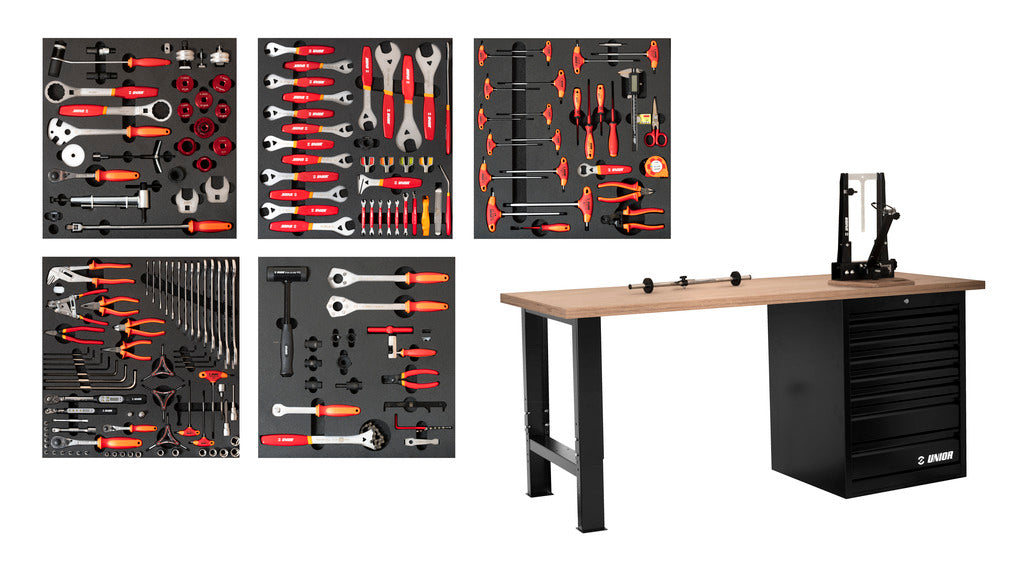
On this page
A single-mechanic shop earning more than a few thousand dollars a month in service revenue runs into the same problem twice a week: the workbench was bought before the service catalog was. Tools that didn’t fit in the original drawer pile up on the bench top, a cassette swap clears a third of the working surface, and the bottom-bracket faceting kit ends up in a milk crate under the bench. The Unior 2600A Professional Mechanic Workbench is sized to outgrow that ceiling: a 2-meter beech-wood top with one integrated 990WD7 cabinet, full-depth modular trays, and 1000 kg of carrying capacity.
What you get
- Bench dimensions: 2 m × 75 cm × 91 cm (L × D × H).
- Weight capacity: 1000 kg on the bench top.
- Bench top: 990TW beech-wood, 4 cm thick, sealed against wear; takes a dropped wrench better than a metal-clad top and reads warmer in the workshop.
- Integrated tool cabinet: Unior 990WD7 (BLACK). Premium PLUS sheet-metal body; central locking with folding key.
- Drawers: seven full-extension, ball-bearing slides; five shallow (564 × 570 × 70 mm), two deep (564 × 605 × 150 mm); 50 kg per drawer; 214 L total volume.
- Workbench code: 629830.
Tool trays included
The 2600A ships with the core service-category foam trays for a single-mechanic shop:
- General Maintenance (SET1-2600AC); daily-use hand tools.
- Bottom Bracket and Crankset (SET2-2600AC); includes the new Hanger Genie 2.0.
- Wheel Tools (SET3-2600AC); truing, spoke wrenches, dishing.
- Torque Tools and Pliers (SET4-2600AC); slipper torque wrench, pliers, snips.
For shops that take on suspension service or routine wheel building, the modular tray system extends with the rest of the Unior tray catalog; bleed kits, wheel-building, frame-prep; bought separately and dropped into the same drawer slots.
2600A vs. 2600C
The 2600C Master Workbench is the upgrade: two integrated cabinets, ten trays covering every Unior service category, and the working surface for two mechanics. The 2600A is the right pick for a one-mechanic shop where the second cabinet would sit half-empty; the 2600C is the right pick once the second mechanic actually shares the bench. Either path supports the modular tray catalog, so a shop that starts with the 2600A and upgrades later doesn’t lose the foam trays it already owns.
Built in Zreče, Slovenia
Unior has been forging hand tools in Zreče since 1919, and sponsors professional road and mountain-bike race teams. The 2600A’s foam trays are cut to the silhouettes of the tools that ship from the same Zreče works, which is what a re-badged generic workbench can’t match; the trays only fit because the trays and the tools come out of the same factory.
Pro tip from our mechanics
The 2600A bench takes about the same floor area as a single-mechanic repair stand plus an aisle. How you orient it relative to the receiving door, the wheel zone, and the parts-station clamp decides whether the shop reaches “every tool within arm’s reach” or stays stuck at “almost there.” Our guide walks through the floor-zoning calls and the order to make them in: How to set up a professional bike workshop →
