
PN: 1722/2BI-US
SKU: 624937
Universal Single-Speed Freewheel Remover
Universal Single-Speed Freewheel Remover
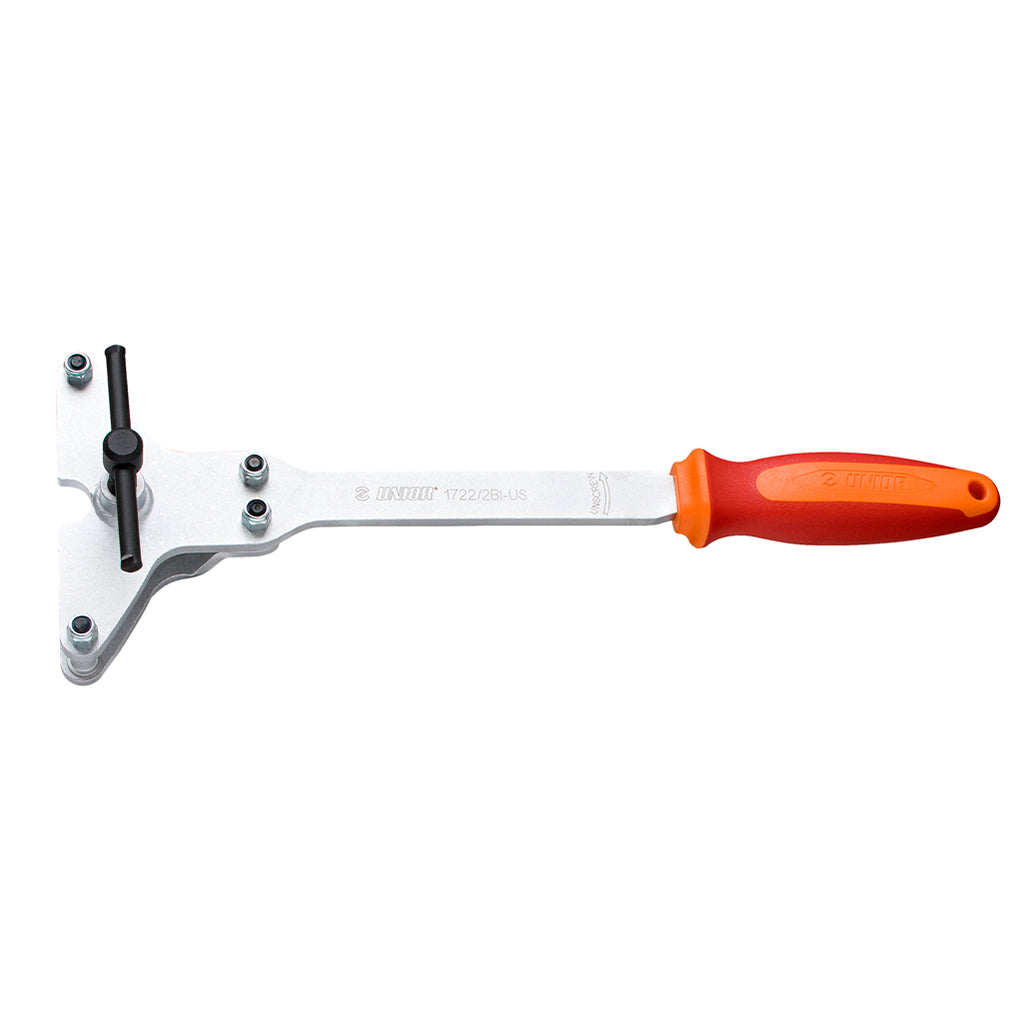
Most freewheel tools need intact engagement notches. This clamp grips the outer body wall instead, so a rounded-off or unidentifiable freewheel still comes off; on corroded hubs the long handle holds sustained torque where a prong tool slips. It's removal-only: a freewheel re-threads by hand and self-tightens on the first pedal stroke.
Low stock
Couldn't load pickup availability
Free US shipping on orders $75+
Some exceptions apply — see shipping policy
Forged in Zreče, Slovenia since 1919. Sponsors professional road and mountain-bike race teams.
View full details
On this page
Anyone who's worked a shop bench knows the freewheel-tool problem. The first drawer has half a dozen patterns; Shimano 4-spline, SunTour 2-prong, SunTour 4-prong, BMX 4-pin, Sachs, the one nobody can identify; and the freewheel that just rolled in has engagement notches rounded off enough that none of them seat. The 1722/2BI-US is the answer for the freewheel that won't take any of the dedicated tools: a body clamp that grips the freewheel's outer perimeter rather than engaging a spline pattern, with a long handle for the leverage to spin it off the hub.
The clamp design is what makes this universal. Spline- and prong-style freewheel tools depend on intact engagement points; a freewheel that's been turned past those points by a wrong-sized tool, or a freewheel from a vintage drivetrain whose tool pattern was never common in the US market, has nothing for those tools to grip. The 1722/2BI-US ignores the engagement points entirely. The clamp tightens against the freewheel body wall, and the handle does the spinning.
It's the tool of last resort for stuck or unidentifiable freewheels, and it's the tool of first resort for shops that don't want to inventory five different prong patterns.
How to use it
Open the clamp and seat it over the freewheel body. Tighten the clamp until it grips firmly; firmly enough that the freewheel body doesn't rotate inside the clamp, not so tight that the freewheel body deforms. Hold the wheel by the rim or in a workstand-mounted dishing fork. Turn the handle counter-clockwise (the same direction every freewheel backs off).
Note: the 1722/2BI-US is for removal. Freewheels self-tighten through pedaling, so a freshly removed freewheel reinstalls by hand-threading onto the hub with a touch of anti-seize. The first hard pedal stroke after wheel install snugs it to working torque.
Compatibility
- Single-speed and multispeed threaded freewheels of essentially any pattern
- Particularly useful for freewheels with rounded or non-standard engagement points
- Works on freewheel bodies up to the clamp's maximum diameter (most current and legacy freewheels)
- Not for cassettes (use the appropriate cassette lockring tool; 1670.5/4 for Shimano/SRAM, 1670.4/4 for Campagnolo)
Specs
- Body-clamp engagement (not spline- or prong-dependent)
- Long handle for leverage on stuck freewheels
- Trivalent chrome plated to ISO 1456:2009
- Bi-material handle grip
- Article number: 1722/2BI-US
Built in Zreče, Slovenia
Unior has been forging hand tools in Zreče since 1919, and sponsors professional road and mountain-bike race teams. The 1722/2BI-US is in the catalog because the freewheel-tool drawer in most shops is honest about its limits; five drawers of dedicated tools still won't fit a sixth pattern that walks in the door. A body-clamp design is the universal-translator solution. It's slower than a dedicated tool when one is the right fit; it's the only thing that works when none of them are.
Pro tip from our mechanics
The 1722/2BI-US has saved more freewheels from "had to cut it off with an angle grinder" than any other tool we own. If the customer's bike has been sitting in a garage long enough that the freewheel is corroded onto the hub, the clamp can apply more sustained torque than a prong tool can without slipping. We've kept freewheels worth saving; vintage Maillard, Sachs hubs, irreplaceable parts; that the dedicated tools couldn't touch. The cassette-replacement workflow has more on the cassette-vs-freewheel call and which tool fits which: When and how to replace your cassette →
FAQ
How does the universal freewheel remover grip a freewheel? A clamp tightens around the outside of the freewheel body rather than engaging any spline or prong pattern, and the long handle turns the whole unit off the hub. Since nothing depends on the engagement notches, it still works when those notches are rounded off or belong to a pattern no dedicated tool in the drawer matches.
Is the 1722/2BI-US used for installing freewheels too? It's removal-only. Freewheels self-tighten under pedaling, so reinstallation is just threading the freewheel back on by hand with a little anti-seize on the threads; your next hard pedal stroke seats it to working torque.
Will the 1722/2BI-US remove a cassette? No. A cassette is held to its hub by a lockring and needs the matching lockring tool: the 1670.5/4 for Shimano and SRAM, the 1670.4/4 for Campagnolo. This clamp is for threaded freewheels, which unscrew from the hub as one complete unit.
 Tech Tips
When and how to replace your cassette
Tech Tips
When and how to replace your cassette
