Choosing the right wrench for hydraulic disc brake service
Which Unior wrench fits which fitting on a hydraulic disc brake: bleed-screw sizes, flare-nut design, compression-nut torque, and what's at stake when one rounds.
On this page
The first time a brake-bleed fitting rounds off in your hand, you stop being casual about wrench selection forever. Hydraulic disc brake fittings are small, soft (usually brass or an aluminium-alloy compression nut), and torqued tight enough that an undersized or wrong-profile wrench bites the wrong way the first turn. Once a fitting is rounded, the choices get expensive: drill it out, replace the line, or carry the bike to someone who has the right tool and the patience for what comes next.
This guide walks through the wrench choices that keep hydraulic brake fittings intact: bleed-nipple sizes, the design difference between open-end and flare-nut wrenches, where compression nuts sit on the size spectrum, and which Unior wrench earns the bench space for each job. We'll cover the bleed screw at the caliper, the compression nut on the hydraulic line, and the banjo bolt that connects the line to the caliper body.
Why hydraulic brake fittings round so easily
Three factors stack against the mechanic.
First, the fittings are small. A 7 mm bleed nipple has less flat-to-flat surface than the smallest pedal-axle nut you'll touch on the same bike. Less surface area means the contact patch between wrench jaws and fitting is small to begin with, and any wrench slop becomes a corner-load on a single flat.
Second, the metal is soft. Bleed screws and compression nuts on hydraulic brake lines are soft metals that yield well below the steel of a wrench. When a wrench corner contacts a flat at an angle, the fitting deforms first.
Third, the torque is real. Bleed screws are torqued enough to seal against fluid pressure, which on a fully bled lever is non-trivial. Compression nuts at the caliper end of a hydraulic line are torqued to the manufacturer's spec sheet. Always check the spec sheet; bicycle brake compression-nut torques vary by manufacturer and aren't interchangeable assumptions.
The combination is the recipe for rounding. The fix isn't more strength; it's the right wrench profile making full-flat contact before you apply torque.
Open-end vs. flare-nut: the engineering difference
An open-end wrench contacts two flats of the fitting. The other four flats carry no load. When you apply torque, the wrench pivots slightly against the contact flats and the corners do the work. On a steel bolt that doesn't matter; on a soft hydraulic-line fitting, the corner is where rounding starts.
A flare-nut wrench (sometimes called a flare wrench, sometimes a line wrench) is a six-point wrench with a slot cut into one side so it can slip over a hydraulic line. The slot is sized so the wrench can rotate the fitting in either direction without unthreading the line. With the slot positioned away from the load, the remaining contact carries on five of the six flats. The load distributes around the fitting instead of pinching two flats and four corners.
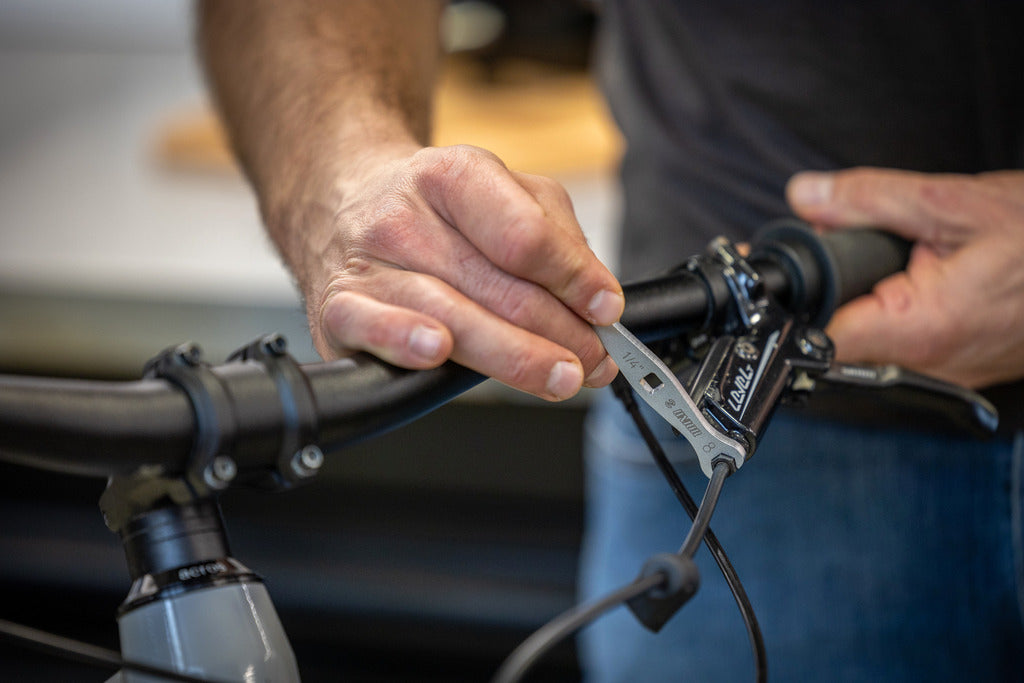
For bleed screws (no line passing through), an open-end wrench gets you onto the fitting easily and the flats are accessible enough that careful work doesn't risk rounding. The 7x8mm Open End Combination Wrench handles bleed screws in both common Shimano sizes from one tool.
For compression nuts where the hydraulic line is passing through the fitting, a flare-nut wrench is the right call. The 8/10mm Flare Nut Wrench and the smaller Flare Nut Wrench 1760/2 (7 mm and 8 mm) both load five of six flats while letting the line pass through the slot.
Bleed nipple sizes you'll encounter
Bleed screw sizes are published in every brake manufacturer's service manual, and you should always check the manual before assuming. The sizes most common in modern hydraulic brakes:
- 7 mm and 8 mm are the two sizes that cover the Shimano hydraulic disc brake range; the bleed screw on a given caliper is one or the other depending on the model. The bleed port is at the caliper, with a rubber dust cover that you pop off before fitting the wrench.
- Other manufacturers use other sizes; check the brake's service manual before ordering a wrench. The pattern is small and metric, and the majority of bleed work in our shop is on Shimano.
The 7x8mm Open End Combination Wrench was designed specifically for the Shimano case, where the caliper might be a 7 mm or 8 mm bleed screw depending on the model year and tier. One tool, two sizes, end of question.
Compression nut sizes and brand spread
Compression nuts (where the hydraulic line threads into the caliper or lever body) run larger than bleed nipples. The size depends on the line diameter and the manufacturer's fitting design. The two-size flare nut wrenches in the Unior catalog cover the common range from opposite ends:
- The Flare Nut Wrench 1760/2 carries 7 mm and 8 mm openings, which overlaps with smaller bleed-nipple sizes for shops that want one flare-nut wrench for both jobs. Low-profile design fits in tight spaces between the caliper body and the frame; the 1/4″ drive end accepts a torque wrench, which matters when manufacturer spec calls for a torqued compression nut.
- The 8/10mm Flare Nut Wrench carries 8 mm and 10 mm openings for the larger compression nuts found on a number of hydraulic systems where the line diameter is wider.
In our shop, a Shimano-heavy road service mix reaches for the 1760/2 most often; a mixed-fleet MTB workload reaches for the 8/10 more. Most full-service shops keep both on the wall.
Torque control on compression nuts
Compression nuts have a manufacturer-published torque spec. Over-torque crushes the olive (the sealing ring inside the fitting) and the next bleed is contaminated by mashed olive material; under-torque leaks. Reading off the spec sheet and using a torque wrench is the only way to land in the middle reliably.
The Flare Nut Wrench 1760/2 is the tool that bridges flare-nut geometry to a torque-wrench drive: the 1/4″ drive end accepts most cycling torque wrenches in the 2 to 24 Nm range. That puts the flare-nut load distribution on the fitting at the same time as a calibrated torque value on the handle. It's the right combination for compression-nut work on a bench where every fitting should land within spec.
Contamination, the silent failure mode
A wrench that's been working on chain lube, on bearing grease, or on a bench with grease residue carries that residue onto whatever it touches next. Brake-fluid contamination by mineral oil (Shimano) or DOT fluid (SRAM, others) crosses brake-system chemistry in ways that don't recover: a Shimano caliper that gets a drop of DOT in its mineral-oil seal stack will need a full reseal at the next service interval. A SRAM caliper that gets mineral oil through it will need the same.
The fix is cheap: a dedicated wrench drawer for brake work, wiped clean between jobs, stored away from the chain-tool drawer. Steel wrench bodies wipe clean with a shop rag and brake cleaner; nothing fancy. Cheap to set up. The hard part is keeping the routine.
Built in Zreče, Slovenia
Unior has been forging hand tools in Zreče since 1919, and sponsors professional road and mountain-bike race teams. The wrench line for hydraulic disc brake service is trivalent chrome plated to ISO 1456:2009 and forged from premium flex plus carbon steel, which is what keeps the wrench flats square against soft fittings without taking a set under torque.
If you've already worked through the rotor, caliper, and piston-spread side of disc-brake service, the next read is Fix disc brake rub →.