How to choose a bike repair stand for your workshop
A buying guide to repair stands across portable, single-arm, double-arm, wall-mount, and electric formats; covers the clamp-mechanism decision and the e-bike capacity question.
On this page
To choose a bike repair stand, match the stand to three things: how often a bike is in it, how heavy your heaviest bike is, and how much floor space you can give up. Occasional home wrenching points to a portable folding stand; daily shop work points to a single-arm floor stand or a wall mount; and once heavy e-bikes enter the mix, the working-capacity rating and the clamp design stop being fine print and become the decision. Everything else, including the clamp mechanism, follows from those three answers.
A repair stand is the foundation everything else in the workshop sits on. The chain tool, the torque wrench, the brake bleed kit; none of them work well if the bike is rocking in front of you. This guide walks through how to match a stand to your workshop, the differences between clamp mechanisms that actually matter, and where Unior's repair stands fit in our own bench routine. We've drafted it for the working mechanic and the serious home builder; the decisions are the same, the scale is different.
Which kind of repair stand do you need?
There are five basic archetypes in any workshop catalog. Four of them are manual stands; the fifth, the electric-lift stand, answers a different question and gets its own section below.
Portable folding stands collapse to fit in a car trunk or a race-day bag. They're the right call for race support, event mechanics, group rides, and home garages where the stand needs to disappear between jobs. They give up some rigidity to gain portability. Our BikeGator portable stand folds down to 5.7 kg and still carries a 30 kg working load, which is enough for the heaviest downhill bike that isn't a full-suspension e-MTB.
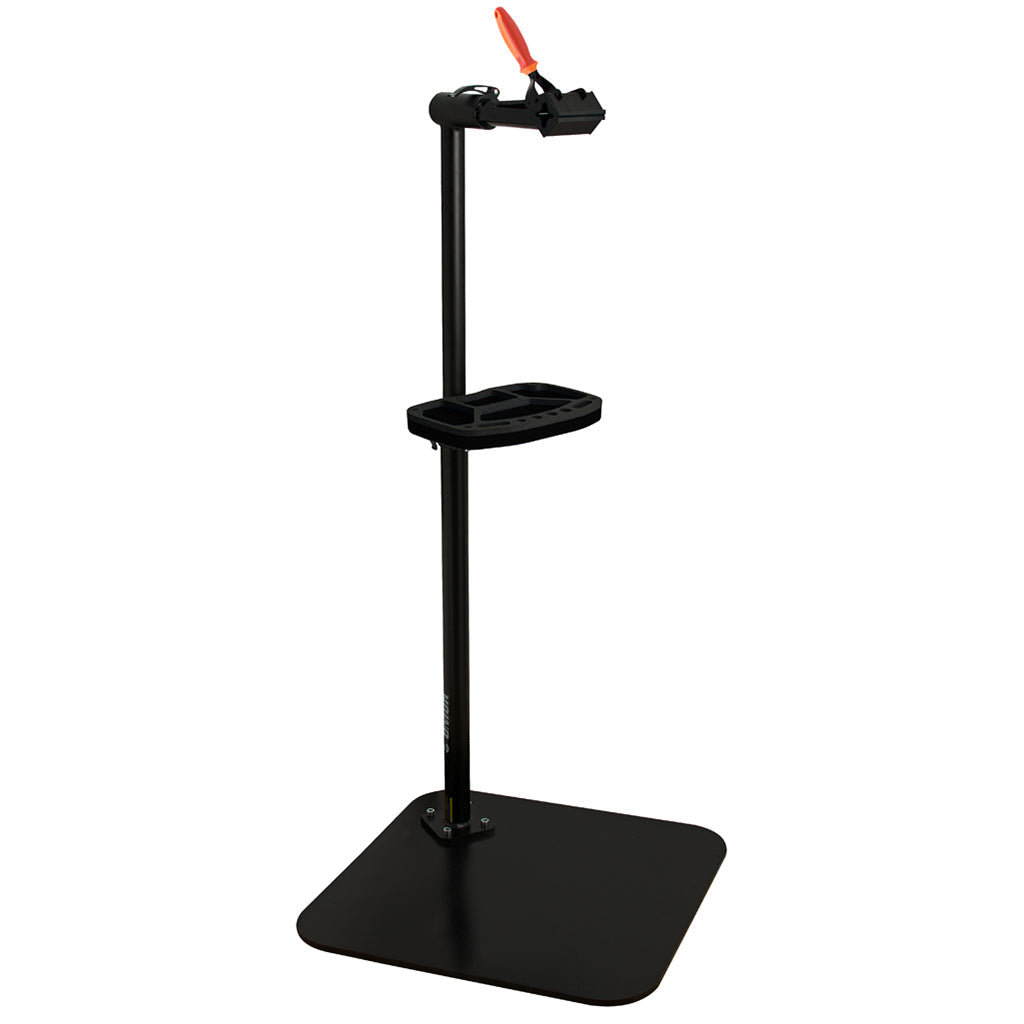
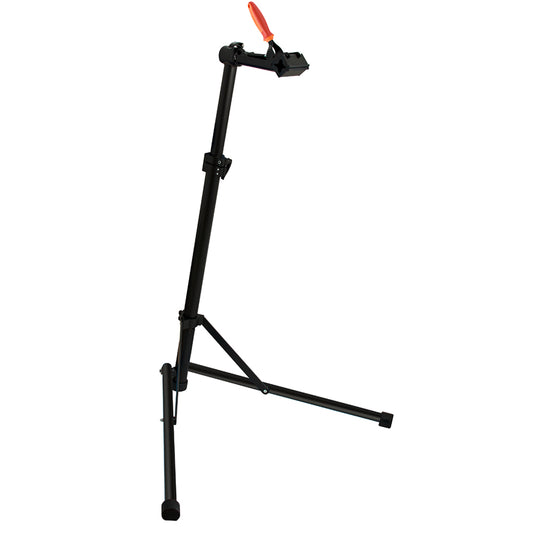
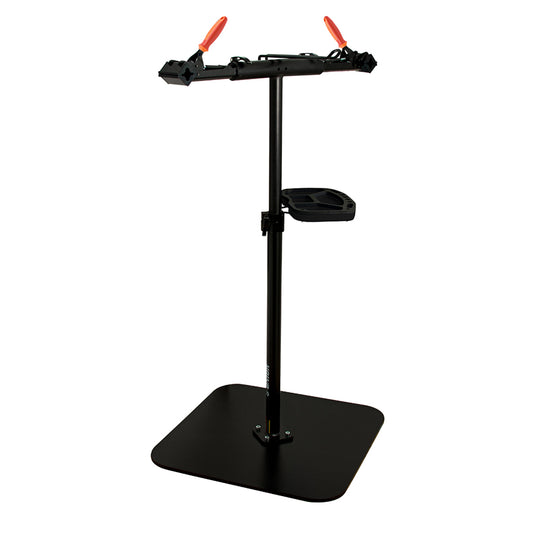
Single-arm professional floor stands are the workhorses of most US bike shops. One column, one clamp, a heavy base that doesn't move when you put your weight on the bars. They take up the floor space of a small bike, last decades, and handle every bike that comes through a typical shop. The Single Arm Pro Repair Stand is the design we built ours around: 36 kg of base-and-column mass under a 30 kg working capacity.
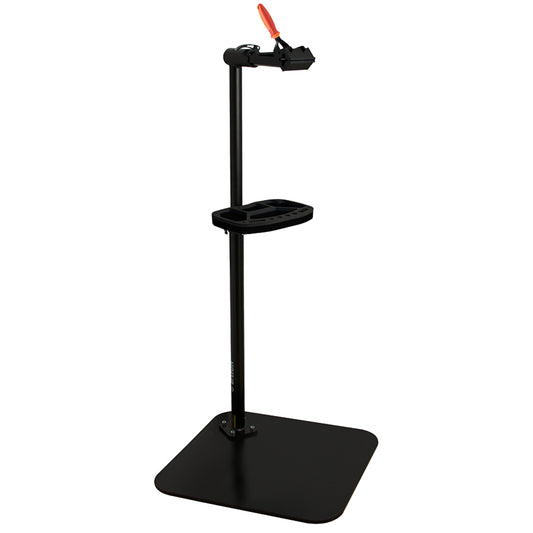
Double-arm professional stands put two clamps on one base so two mechanics can work back-to-back without crowding each other. If your shop runs more than one wrench during peak season, the Double Arm Professional Repair Stand doubles your bench utilization without doubling the floor footprint. It's a busy-shop tool; if you're working alone, a second single-arm stand is usually the better answer because you can position them independently.
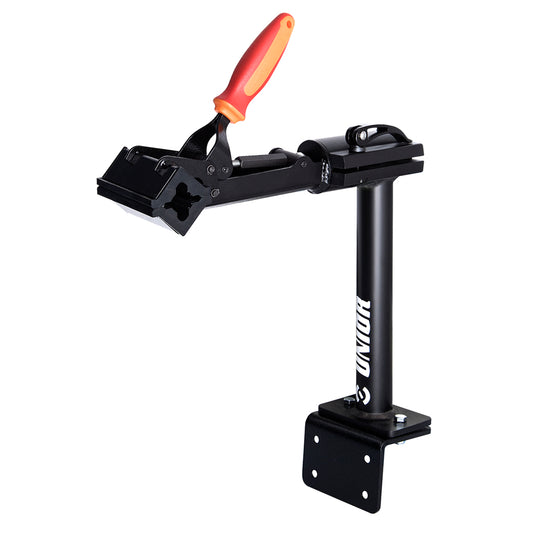
Wall and bench-mounted stands trade portability and adjustability for a permanent install. The clamp sits where you mounted it; nothing wobbles, nothing rolls, and the floor is clear. The Wall or Bench Mounted Repair Stand is the small-shop and serious-home-garage answer: 240 mm of standoff from the wall, jaws sized 24 to 40 mm, and no floor footprint. It's also the right call for a dedicated tubeless-setup station or a fork-service bench where the bike doesn't need to rotate.
Electric-lift stands raise the bike to working height with a motor instead of the mechanic's back. They're a capital-equipment decision more than a tool decision, and as e-bikes have filled service queues they've moved from curiosity to fixture. The next section covers when one earns the money.
Best repair stand for heavy e-bikes
Repair-stand capacity ratings describe the working load the clamp will hold without slipping or flexing the column. Most of our stands carry 27 to 45 kg working capacity. A typical road bike is 7 to 10 kg; a full-suspension e-MTB is often 22 to 26 kg with battery. The capacity rating becomes load-bearing once a shop's mix tilts e-bike-heavy, and it's the first number to check before any feature list.
For e-bike work in a manual stand, the clamp head is the upgrade that matters most. The short-jaw Master Shop Clamp (covered in the clamp section below) had its jaws reshaped around heavy e-bikes: a short bite for the little exposed seatpost a full-suspension e-MTB offers, and a wide opening for deep aero seatpost shapes. A properly rated manual stand with that head handles routine e-bike service without drama.
What a manual stand can't fix is the lifting. The stand holds 25 kg all day without complaint; the mechanic hoisting 25 kg to chest height every twenty minutes is another matter, and that's the problem the Unior Electric Repair Stand 2.0 exists to solve. Press the button or step on the foot pedal and the column lifts bikes up to 70 kg (about 154 lb) to working height; there are no preset stops, the column travels until you release and holds position automatically, and a travel limiter with a memory function brings the clamp back to your most-used height without re-measuring. A built-in load display reads the bike's weight at every lift, and the safety system halts the column on overload. The clamp is the same Master Shop Repair Clamp 1693.1M specified across our pro stand line, so the jaw behavior on carbon and aluminum frames doesn't change; what changes is that nobody lifts the bike. The one-piece aluminum column routes all wiring internally, tops out at 1750 mm, and gives about 1510 mm of vertical travel. It installs to the floor directly or onto a heavy-duty fixed plate, sold separately.
Who it pays back for: shops where the bench mechanic is lifting bikes more than ten times a day; high-volume retail service, e-bike-heavy service catalogs, and mechanics whose backs are logging the cost of repeated lifts. For a shop that turns four bikes a day and runs mostly road and gravel, a manual stand stays cost-justified. If you want to weigh the whole spectrum from portable to electric in one place, the repair stands collection lists every format side by side.
Clamp mechanisms: the trade-offs that matter
The clamp is the part of the stand you'll interact with hundreds of times a day. Picking the wrong mechanism is the most common stand-buying regret, so we'll spend more time here than the spec sheets usually do.
A cam-style traditional clamp is the simplest mechanism. A lever rotates a cam that drives the jaw closed; release the lever, the jaw opens. Adjustment for tube diameter is a separate threaded handle. Cam clamps are reliable, hold well, and have very few moving parts to wear out. They're slower for high-throughput shops because every bike change requires two motions: open the cam, then adjust the diameter.
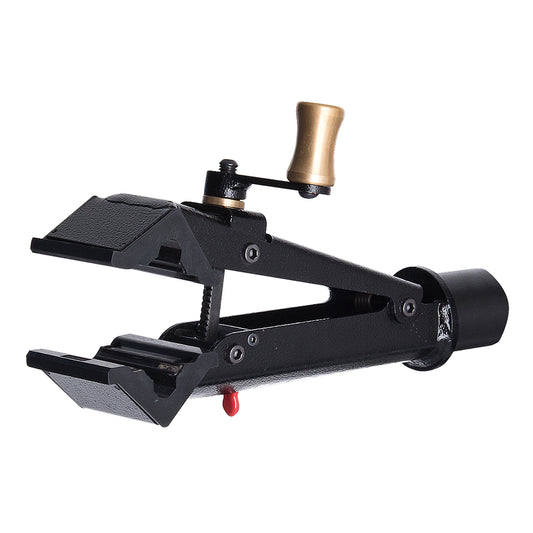
The Pro Shop Clamp 1693.1Q is our quick-release answer. A brass handle dials in the clamping pressure to the tube; a separate quick-release button drops the jaw open for the next bike without losing the pressure setting. It clamps tubes from 22 to 60 mm. The 70 mm jaw height is 25 mm shorter than a traditional clamp, which is the detail that matters on small road frames and any bike with a dropper post; the clamp clears the dropper stanchion area without you having to find the one safe spot to grab.
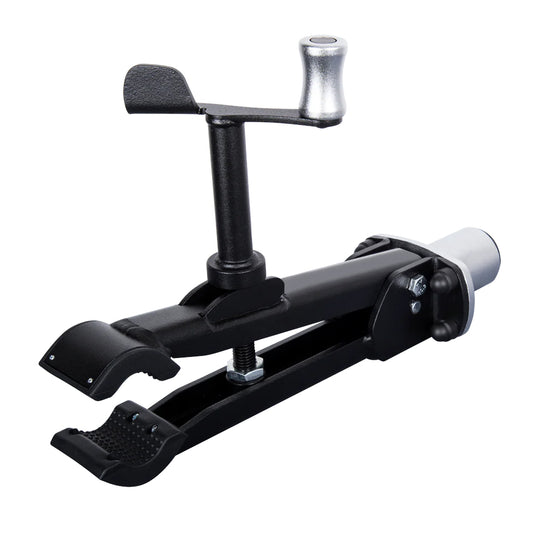
The Master Shop Clamp 1693.1M removed the quick-release and shortened the jaws to 5 cm tall. Bikerumor's coverage on its 2021 release framed the design move directly: "Unior has updated their premium repair clamp with a more rugged, more rigid design to work with modern bikes and heavy e-bikes." The short jaws bite securely on bikes with very little exposed seatpost (modern aero road, most full-suspension e-MTBs); the wider 110 mm opening accommodates the deep aero seatpost shapes. The trade-off is that you give up the speed of the quick-release. For an e-bike-heavy shop, the trade is worth it; for a road shop doing fast pad swaps and tune-ups, the Pro Shop Clamp is faster.
Replaceable rubber jaw covers (Unior part 1693.11) fit every clamp in our line. When the rubber wears, you replace the rubber, not the clamp. It's a small thing on a one-bike home stand; it's a meaningful cost difference across a five-year shop horizon.
Thru-axle bikes and modern frame fitment
Two complications appear on most modern bikes. The first is thru-axle dropouts, which can't slot into a portable fork-mount stand without an adapter. The Thru-axle Adaptor for 1693R Pro Road Stand is the bolt-on solution for road and gravel use. The second is integrated cable routing, which means you don't want to clamp on the down tube if you can avoid it. Clamp on a non-routing tube (top tube, seat tube, or a seatpost extension) and you'll never need to drop a clamp to chase a brake line that the jaw was pressing on.
The 5.1 kg Pro Road Stand, developed with the team now riding as Ineos Grenadiers (Team Sky at the time), supports the bike at the bottom-bracket area instead of clamping a frame tube; the thru-axle adapter (sold separately) extends compatibility to modern thru-axle road and gravel bikes. For road-only shops or for traveling mechanics, the frame-area mount is the faster setup.
Event and race-day setups
Race tents and group-ride mechanics need to set up a line of bikes fast and break it down faster. The Event Stand 1693F is built for that pattern: a modular bar that holds up to 10 bikes by the saddle, no clamping, no tools to set up, an 8.2 kg total weight, and a carrying bag included. It isn't a repair stand in the wrench-it-up sense; it's a holding line for bikes waiting their turn. Pair it with a portable repair stand and one mechanic can work a 50-rider event.
Why are bike repair stands so expensive?
Because the two things a stand exists to provide, stillness and grip, are both expensive to build. Stillness is mass: the Single Arm Pro puts 36 kg of base and column under a 30 kg working load, and that ratio is what keeps the bars from moving when you lean on a stuck bottom bracket. Grip is clamp engineering: jaws that span tubes from 22 to 60 mm, clear a dropper stanchion, and bite a carbon aero seatpost without crushing it. A cheap stand economizes on exactly those two line items, which is why it wobbles under load and why its jaws either slip or scar.
The other half of the price is service life. A professional stand is a decade tool; the wear part is a replaceable rubber jaw cover, not the clamp and not the column. Spread across the years a shop stand actually works, the expensive stand usually turns out to be the cheaper one.
Built in Zreče, Slovenia
Unior has been forging hand tools in Zreče since 1919, and sponsors professional road and mountain-bike race teams. Our repair-stand line has been built and refined alongside that team support; the Pro Road Stand was shaped over two seasons of team-mechanic feedback, and the Master Shop Clamp reshaped its jaws in 2021 around the working reality of heavy e-bikes coming off the factory truck and onto the bench. Stand design is one of those tool categories where you can tell quickly whether the company that makes the stand also has mechanics turning wrenches in front of one.
How to pick one stand if you can only buy one
For most home mechanics with one or two bikes, a portable folding stand is the right starting point. The BikeGator handles any bike you're realistically working on at the floor space and price of a checked bag, and it gets out of the way when the work's done.
Once a home garage starts looking like a small fleet (five bikes, a partner's, a couple of kids', your own race bike), a single-arm shop stand earns its space on the floor. The clamp head outlasts the cheaper alternatives by years, and the Pro Shop Clamp saves a few seconds on every bike swap; multiplied across a decade of weekend wrenching, those seconds add up.
For shops, the answer is usually two-tier. One mechanic on the floor most days: a single-arm stand, Master Shop Clamp head if the e-bike mix is heavy. Two mechanics at peak: a double-arm stand for the bench plus a portable for the back room. Road-race tents with rotating mechanic crews: the 5.1 kg Pro Road Stand lives in the support car, paired with an Event Stand for the holding line. And once most of a day's queue is 22-to-26 kg e-bikes going up and down the column, the Electric Repair Stand 2.0 stops being a luxury and starts being the reason the lead mechanic still wants to wrench at fifty.
Once the stand is picked, two companion guides finish the job: where to clamp a bike without wrecking the frame and how to set up the workshop around it.
Tools used in this guide
Straight from the article — no hunting through the catalog.
-
Bike Gator Portable Repair Stand
Regular price $279.99 USDRegular priceUnit price per -
Single Arm Professional Repair Stand Manual Adjust Lever
Regular price $449.99 USDRegular priceUnit price per$599.99 USDSale price $449.99 USDSale -
Double Arm Professional Repair Stand Traditional Cam
Regular price $562.49 USDRegular priceUnit price per$749.99 USDSale price $562.49 USDSale -
Wall or Bench Mounted Repair Stand Cam Style Lever
Regular price $281.99 USDRegular priceUnit price per -
 Sale
SalePro Shop Clamp
Regular price $182.99 USDRegular priceUnit price per$243.99 USDSale price $182.99 USDSale -
 Sale
SaleMaster Shop Clamp
Regular price $179.99 USDRegular priceUnit price per$239.99 USDSale price $179.99 USDSale
Frequently asked questions
How do I choose a bike repair stand?
Match the stand to three things: how often a bike is in it, how heavy your heaviest bike is, and how much floor space you can give up. Occasional home wrenching points to a portable folding stand; daily shop work points to a single-arm floor stand or a wall mount; heavy e-bikes make capacity and clamp design the deciding factors.
What repair stand works for heavy e-bikes?
Check the working-capacity rating first: a full-suspension e-MTB runs 22–26 kg with its battery, and most Unior stands are rated for 27–45 kg working loads. In a manual stand, a short-jaw clamp head reshaped for the short exposed seatpost on a full-suspension e-bike is the upgrade that matters most.
Why are bike repair stands so expensive?
Because stillness and grip both cost money to build. Stillness is mass: the Single Arm Pro puts 36 kg of base and column under a 30 kg working load, and that ratio is what keeps the bars still when you lean on a stuck bottom bracket. Grip is clamp engineering: jaws that span 22–60 mm tubes and hold a carbon aero post without crushing it.
How much weight can a portable repair stand hold?
The BikeGator portable folds down to 5.7 kg and still carries a 30 kg working load, enough for the heaviest downhill bike short of a full-suspension e-MTB. Portability costs some rigidity, which is the trade you accept for race-day and car-trunk duty.
Are wall-mounted repair stands worth it?
For a small shop or a serious home garage, yes. A wall or bench mount trades portability for a permanent install that doesn't wobble and takes no floor space, with 240 mm of standoff and jaws sized 24–40 mm. It also suits a dedicated tubeless-setup or fork-service station.