

A cone wrench earns its keep in the few millimeters between a hub cone and its locknut, where a standard wrench is too thick to reach. The 1612/2 is ground thin for that gap and sized for the cone flats on workshop-common Shimano cup-and-cone hubs, with the entry-grade build for home benches and second-bench shops.
In stock
Couldn't load pickup availability
Free US shipping on orders $75+
Some exceptions apply — see shipping policy
Forged in Zreče, Slovenia since 1919. Sponsors professional road and mountain-bike race teams.
View full details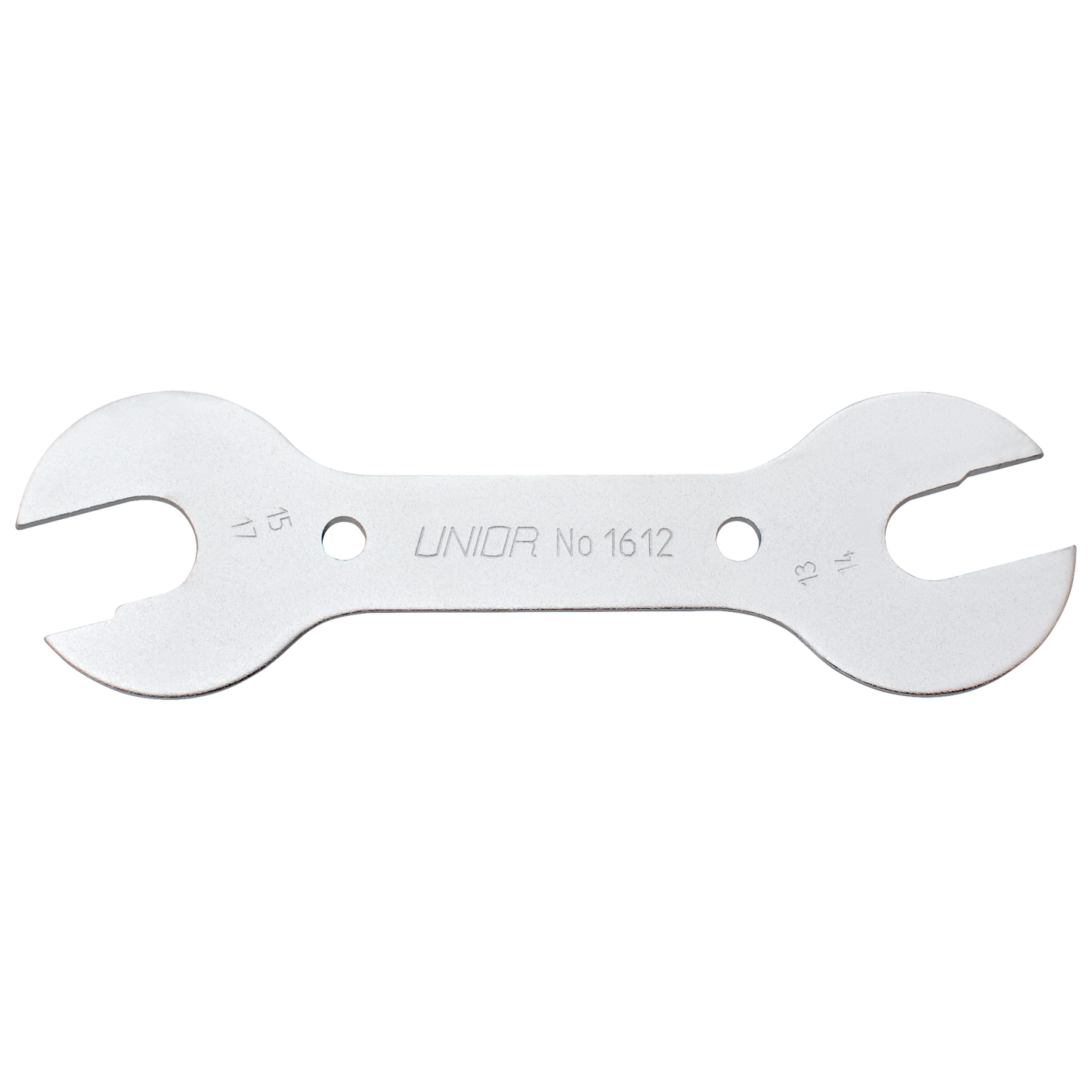
On this page
A hub cone wrench has to be thin enough to fit between the cone and the locknut on a cup-and-cone hub, strong enough to hold the cone steady while a second wrench torques the locknut against it, and flat enough on the working faces that it doesn't round the cone's flats after a few service cycles. The 1612/2 is the entry-grade Unior cone wrench built around those three constraints, sized for the four hub cone widths a home or shop mechanic encounters across most current and recent-generation Shimano hubs.
How it works
Hub cone wrenches engage on the cone's two parallel flats, the same way a standard open-end wrench engages a nut. The difference is the wrench body's thickness: a hub locknut sits within a few millimeters of the cone face, and a standard combination wrench is too thick to clear the locknut while engaging the cone. The 1612/2 is ground to a thin enough body to slide into the cone-and-locknut gap, with the open end shaped for the cone flats.
The wrench is used in pairs. One wrench holds the cone at preload; the second torques the locknut against it. This is the workflow that converts a hub's adjustable cone preload into a fixed running condition.
Spec
- Material: premium flex plus carbon steel
- Surface finish: chrome plated to ISO 1456:2009 (trivalent chromium; meets current EU consumer-tool standards for plating durability and corrosion resistance)
- Body geometry: thin profile sized for cone-to-locknut clearance on current hub designs
The four cone sizes the 1612/2 family covers are the workshop-common hub flats. For a wider sized range and heat-treated steel, the Cone Wrench 1617/2DP-US covers 13 through 40 mm.
Compatibility
The 1612/2 works on the workshop-common cup-and-cone hub designs across Shimano's current hub line, and on the cup-and-cone hubs that share the same cone flats elsewhere in the catalog. The wrench fits the cone flats themselves; it does not engage hub-cap flats on cartridge-bearing hubs (those use the Hub Genie 1758/4 workflow instead).
Built in Zreče, Slovenia
Unior has been forging hand tools in Zreče since 1919, and sponsors professional road and mountain-bike race teams. The 1612/2 is built to the same dimensional spec as the rest of the Unior cone-wrench line, with the entry-grade material and finish that fits the home-mechanic and second-bench shop applications. The wrench will outlast the hub it's servicing if the locknut never sees more than the snug-against-cone preload a hub bearing actually needs.
Pro tip from our mechanics
Cup-and-cone hubs are easier to fine-tune than people think they are. Snug the cone in by feel until the axle just begins to drag, back it off about a sixteenth of a turn, and lock the locknut against it. Spin the wheel: if it spins freely with no notchy feel, you're done; if it grumbles, the cone is too tight and the bearings are loaded. Re-feel until you find the spot where the bearings turn under load only when the wheel is on the bike. The whole hub-service workflow is at Bearing and headset service: a workshop guide →
FAQ
What is a cone wrench (also called a cone spanner) used for? A cone wrench is a thin, flat open-end wrench for adjusting bearing preload on cup-and-cone bicycle hubs. Because the locknut and the cone sit only a few millimeters apart, the wrench body is ground thin enough to slide into that gap and grip the cone's two parallel flats.
Why are cone wrenches used in pairs? Because the adjustment only holds if the cone can't move while the locknut clamps down on it. One wrench keeps the cone from turning at the preload you've chosen; the other tightens the locknut, and the two faces jam together to freeze that setting in place.
Which hubs does the 1612/2 cone wrench fit? It fits the cone flats on workshop-common cup-and-cone hubs, including most Shimano hubs of the current and recent generations. It does not engage the hub-cap flats found on cartridge-bearing hubs, which take a different workflow. If you need a wider size range, the heat-treated Cone Wrench 1617/2DP-US runs from 13 mm to 40 mm.
 Tech Tips
Bearing and headset service: a workshop guide
Tech Tips
Bearing and headset service: a workshop guide
